Revenue Cycle Module

EMR Billing & Collections Feature for Claims, Payments, Denials & A/R

EMR-EHRs Billing & Collections Feature helps practices manage charge capture, claim readiness, claims, payment posting, denials, unpaid claim follow-up, patient balances, A/R aging, and revenue cycle reports in one connected workflow.
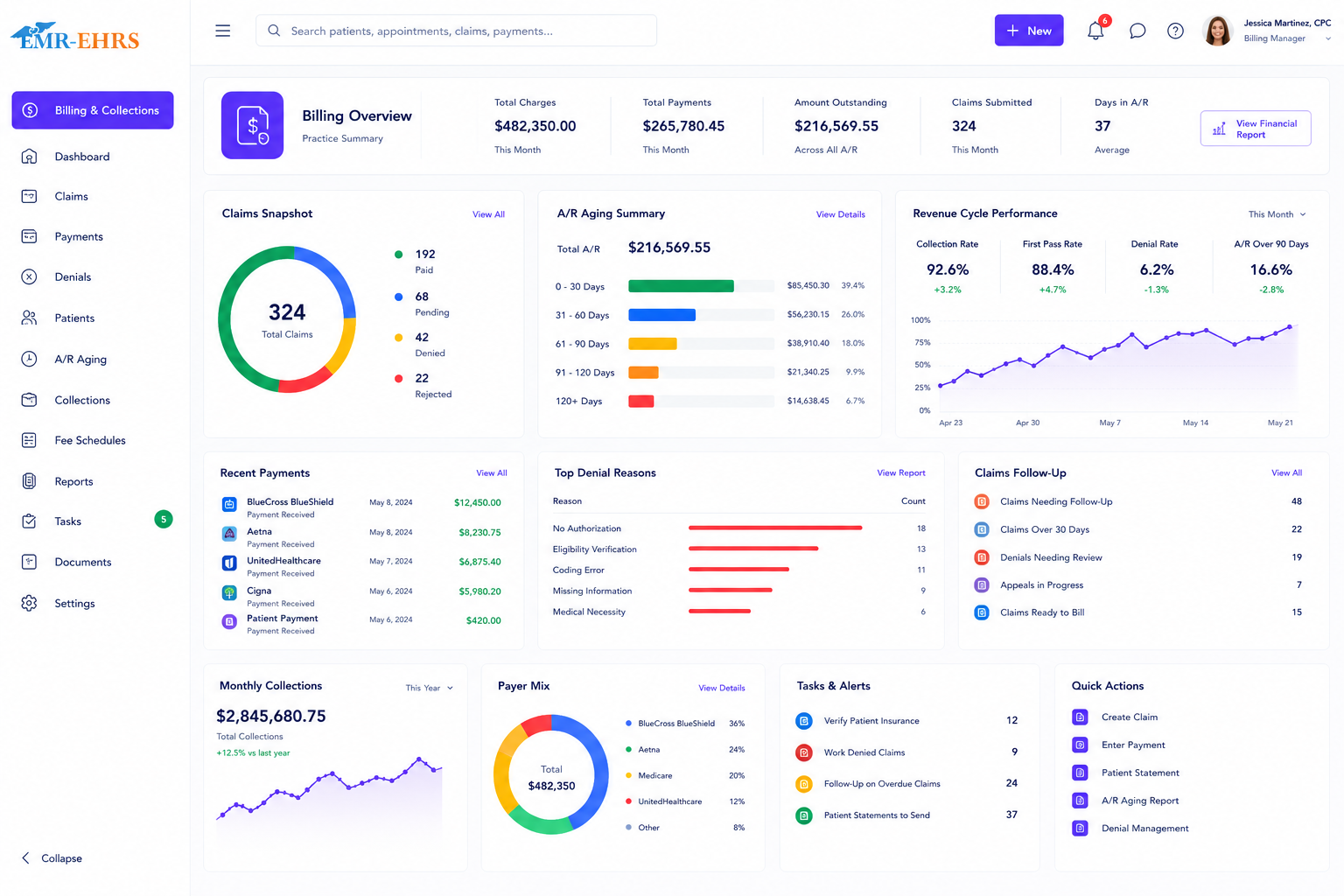
Billing and Collections dashboard with claims snapshot, A/R aging, revenue cycle performance, payments, denial reasons, follow-up tasks, and reports
Charge CaptureClaim ChecksElectronic ClaimsPayment PostingDenialsA/RPatient CollectionsReports
Quick answer

What Is EMR Billing and Collections Feature?

EMR billing and collections Feature is a revenue cycle module that helps healthcare practices manage charge capture, superbill data, claim creation, claim validation, electronic claim submission, payment posting, denial tracking, unpaid claim follow-up, patient balances, collections, A/R reports, and financial visibility inside a connected EMR and practice management workflow.

EMR-EHRs Billing & Collections Feature helps practices connect clinical documentation, superbills, procedure codes, diagnosis codes, claims, payments, denials, patient balances, collections, and revenue reports in one billing workflow.

Why Practices Need Integrated Billing and Collections Feature

Healthcare practices need more than basic claim entry. They need a connected billing workflow that links documentation, charges, claims, payments, denials, patient balances, collections, and reports.

Charges Can Be Missed or Delayed

Practices need a clear workflow to move encounter data, superbills, CPT codes, ICD-10 codes, modifiers, provider details, and service dates into billing-ready charges.

Superbill Data Entry Can Create Manual Billing Work

Manual superbill entry can slow billing teams, increase duplicate work, and create delays between clinical documentation and claim creation.

Claims Need Validation Before Submission

Claims may need review for missing patient information, missing insurance details, invalid codes, missing modifiers, authorization issues, payer rules, and documentation gaps.

Missing Patient or Insurance Details Can Delay Claims

Incomplete demographics, policyholder information, secondary insurance, eligibility details, or patient responsibility information can slow claim submission.

CPT, ICD-10 and Modifiers Need Structured Review

Billing teams need structured review for procedure codes, diagnosis codes, modifiers, units, fee schedules, and payer-specific requirements.

Payer-Specific Claim Rules Need Organized Workflows

Different payers may require different forms, coding rules, authorization details, claim edits, fee schedules, and documentation requirements.

Rejected and Denied Claims Need Fast Correction

Rejected and denied claims need reason tracking, correction workflows, re-submission, appeal tasks if supported, and follow-up visibility.

Unpaid Claims Need Active Follow-Up

Billing teams need worklists for unpaid claims, aging claims, payer follow-up, re-bill tasks, and unresolved claim status.

Payment Posting Must Stay Accurate

ERA, EOB, adjustments, contractual allowances, write-offs, deductibles, co-insurance, co-pays, and patient responsibility need organized posting workflows.

Patient Balances Need Statement and Collection Workflows

Practices need patient statements, payment posting, collection notes, payment plans if supported, online payment workflows if supported, and balance follow-up.

A/R Aging Needs Daily Visibility

Administrators need visibility into insurance A/R, patient A/R, aging buckets, unpaid claims, collection worklists, payer delays, and provider-level financial performance.

Billing Reports Must Show Revenue Cycle Performance

Billing reports should show claims, payments, denials, unpaid claims, A/R, collections, revenue by provider, revenue by payer, and revenue by location.

Billing Records Must Stay Secure and Audit-Friendly

Revenue cycle records should support user permissions, claim history, payment history, denial history, adjustment history, and audit-friendly billing documentation.

How EMR-EHRs Billing & Collections feature Works

1

Patient Registration and Demographic Capture

Capture patient name, date of birth, contact details, address, responsible party, billing contact information, and patient account details.

2

Insurance Capture and Policyholder Details

Capture primary insurance, secondary insurance if applicable, policyholder details, payer information, member ID, group number, and patient responsibility details.

3

Eligibility and Billing Readiness Review If Supported

Review eligibility, payer rules, missing insurance details, missing demographic fields, authorization requirements if applicable, patient balances, and billing alerts.

4

Superbill or Encounter-Based Charge Capture

Use superbills, encounter details, procedure codes, diagnosis codes, modifiers, units, provider details, location details, and service dates to prepare charges.

5

CPT, ICD-10, Modifier, Provider, Location and Fee Schedule Review

Review CPT codes, ICD-10 codes, modifiers, units, place of service, provider details, location details, fee schedules, and payer-specific requirements.

6

Pre-Claim Checks and Claim Validation

Check missing fields, invalid code combinations if supported, payer requirements, eligibility issues if supported, authorization issues if applicable, and documentation gaps if supported.

7

Claim Creation

Create primary claims, secondary claims, CMS-1500 claims, UB-04 claims, and workers compensation forms where applicable.

8

Electronic Claim Submission If Supported

Submit claims electronically through supported claim workflows or clearinghouse workflows where configured.

9

Claim Status Tracking

Track submitted, accepted, rejected, denied, pending, paid, unpaid, and partially paid claims.

10

Rejected Claim Correction

Review rejection reasons, correct missing or invalid information, update claim details, and resubmit where supported.

11

Denial Tracking and Follow-Up

Track denial reasons, payer trends, provider trends, location trends, correction tasks, appeal tasks if supported, and re-billing status.

12

ERA/EOB Payment Posting

Post ERA payments if supported, EOB payments, insurance payments, patient responsibility, adjustments, contractual allowances, co-pays, deductibles, co-insurance, and write-offs.

13

Patient Responsibility Transfer

Transfer remaining patient responsibility after insurance adjudication, including deductibles, co-insurance, co-pays, and unpaid patient portions.

14

Patient Balance Tracking

Track open patient balances, patient statements, payment history, payment plans if supported, collection notes, and patient billing status.

15

Patient Statements and Collections Workflow If Supported

Manage patient statements, balance follow-up, collection letters if supported, payment reminders if supported, online payment workflows if available, and collection status.

16

Unpaid Claim and A/R Follow-Up

Track unpaid claims, aging buckets, payer follow-up tasks, patient balance follow-up, re-bill worklists, collection worklists, and unworked claims.

17

Billing, Payment, Denial, Collection and Revenue Reports

Review claim reports, payment reports, denial reports, A/R reports, collections reports, revenue reports, provider reports, payer reports, and location reports.

Verify Insurance and Billing Readiness Before Claims Move Forward

Only claim eligibility verification, authorization checking, or patient responsibility estimates when EMR-EHRs supports those workflows.

Patient demographics review
Insurance capture
Primary insurance details
Secondary insurance details if applicable
Policyholder details
Member ID and group number
Eligibility review if supported
Authorization status if applicable
Referral details if applicable
Patient responsibility details if available
Missing insurance alerts
Missing demographic alerts
Patient balance alerts
Billing readiness status
Front desk billing alerts
Claim preparation readiness

Turn Superbill and Encounter Data Into Billing-Ready Charges

Only claim automatic charge capture, encounter-to-billing transfer, or superbill automation when EMR-EHRs supports that workflow.

Automated superbill data entry if supported
Encounter-to-billing workflow if supported
Procedure code capture
Diagnosis code capture
Modifier capture
Units
Date of service
Provider details
Location details
Place of service
Referring provider if applicable
Authorization details if applicable
Charge review queue
Missing charge alerts if supported
Billing-ready status

Manage CPT, ICD-10, Modifiers and Fee Schedules

CPT code support
ICD-10 code support
Modifier support
Units
Place of service
Fee schedule setup
Payer-specific fee schedules if supported
Provider fee schedules if applicable
Location-based fee schedules if applicable
Charge amount review
Contracted rate visibility if supported
Code-to-claim readiness
Coding review workflow
Billing rule review if supported

Check Claims Before Submission to Reduce Avoidable Errors

Pre-claim analysis
Claim checking
Claim validation
Claim scrubbing if supported
Missing patient information alerts
Missing insurance alerts
Missing diagnosis code alerts
Missing procedure code alerts
Modifier checks if supported
Eligibility issue alerts if supported
Authorization issue alerts if applicable
Payer rule validation if supported
Documentation gap alerts if supported
Claim readiness status
Staff review before submission

Submit Primary, Secondary and Paper-Compatible Claims

Primary electronic claims
Secondary electronic claims
CMS-1500 claim support
UB-04 claim support
Workers compensation forms if applicable
Clearinghouse workflow if supported
Claim batch creation
Claim submission status
Claim rejection tracking
Claim correction workflow
Claim re-submission workflow
Claim history
Paper-compatible claim workflows if applicable

Track Every Claim From Submission to Payment

Submitted claims
Accepted claims
Rejected claims
Denied claims
Pending claims
Paid claims
Unpaid claims
Partially paid claims
Claim status worklists
Payer response tracking
Clearinghouse response tracking if supported
Follow-up tasks
Re-billing tasks
Claim notes
Claim owner assignment if supported
Claim aging visibility

Post Insurance Payments, Adjustments and Patient Responsibility

Only claim ERA automation, auto reconciliation, or payment posting automation when EMR-EHRs supports those workflows.

ERA posting if supported
EOB posting
Auto reconciliation if supported
Insurance payment posting
Patient payment posting
Co-pay posting
Deductible posting
Co-insurance posting
Contractual adjustments
Write-offs
Secondary balance transfer
Patient responsibility transfer
Payment history
Posting exceptions
Reconciliation reports
Payment posting worklists

Manage Denials, Corrections, Appeals and Re-Billing Tasks

Denial tracking
Rejected claim tracking
Denial reason codes
Denial categories
Payer-specific denial trends
Provider denial trends
Location denial trends
Missing information denials
Coding denials
Eligibility denials
Authorization denials if applicable
Medical necessity denials if applicable
Correction workflow
Appeal task workflow if supported
Re-billing unpaid claims
Denial follow-up reports
Denial status visibility

Manage Patient Balances, Statements and Collections Workflow

Patient balance tracking
Patient responsibility transfer
Patient statements
Family billing if supported
Payment plans if supported
Patient payment posting
Online payment workflow if available
Collection notes
Collection letters if supported
Payment reminders if supported
Aging patient balances
Patient communication history
Bad debt workflow if supported
Collection status tracking
Patient billing history
Payment receipt history

Track A/R Aging, Unpaid Claims and Follow-Up Tasks

A/R aging
Insurance A/R
Patient A/R
Unpaid claims
Aging buckets
0-30 days
31-60 days
61-90 days
90+ days
Payer follow-up tasks
Patient balance follow-up
Unworked claim lists
Re-bill worklists
Collection worklists
A/R by provider
A/R by payer
A/R by location
A/R by service type if supported

Support Patient Payment Follow-Up and Collection Communication If Supported

Only claim online payments, payment links, automated reminders, payment plans, or portal balance visibility when EMR-EHRs verifies support.

Patient statements
Payment reminders if supported
Online payment links if supported
Portal balance visibility if supported
Payment plans if supported
Collection notes
Collection letters if supported
Family billing if supported
Patient responsibility breakdown
Patient billing history
Payment receipt history
Collection status

Connect Billing With Front Desk, Provider and Back-Office Workflows

Front desk insurance capture
Eligibility review if supported
Co-pay collection if supported
Patient balance alerts
Provider documentation connection
Superbill review
Charge review
Billing team worklists
Claims team workflow
Payment posting workflow
Denial worklists
Collection worklists
Administrator dashboards
Multi-user billing workflow
Role-based task visibility

Billing and Collections for Specialty, Multi-Provider and Multi-Location Practices

Specialty billing workflows
Multi-provider billing
Multi-location billing
Provider-specific reports
Location-specific reports
Payer-specific rules if supported
Specialty-specific CPT workflows if supported
Procedure billing if supported
Therapy billing if applicable
Surgery billing if applicable
Urgent care billing if applicable
Pain management billing if applicable
Podiatry billing if applicable
Multi-specialty billing operations
Centralized billing team workflow if supported

HIPAA-Focused Billing Feature for Secure Revenue Cycle Records

HIPAA-focused billing workflows, designed to support secure billing documentation, audit-friendly revenue cycle records, and secure patient financial records.

Role-based access
User permissions
Password protection
Access logs if supported
Change logs if supported
Claim history
Payment history
Adjustment history
Denial history
Patient billing history
Audit-friendly billing records
Secure patient financial records
Privacy-focused billing workflows
Secure revenue cycle records

Connect Billing With EMR, Claims, Payments and Practice Management Workflows

Only list specific clearinghouses, payers, payment systems, portals, APIs, or integrations when EMR-EHRs verifies support.

EMR documentation connection
Superbill workflow
Practice management workflow
Electronic claims workflow
Clearinghouse workflow if supported
ERA/EOB workflow
Patient portal balance workflow if supported
Payment workflow if supported
Scheduling workflow
Eligibility workflow if supported
Document management workflow
Reports workflow
Data migration if applicable
Secure document exchange if supported

Billing Reports, Collections Visibility and Revenue Cycle Analytics

Use visibility, tracking, and reporting language for billing performance while avoiding unsupported financial outcome claims.

Claim Reports

  • Claims submitted
  • Claims accepted
  • Claims rejected
  • Claims denied
  • Claims paid
  • Claims pending
  • Unpaid claims
  • Re-billed claims
  • Claim status by payer
  • Claim status by provider
  • Claim status by location
  • Claim status by service type if supported

Payment Reports

  • Insurance payments
  • Patient payments
  • ERA posting reports
  • EOB posting reports
  • Adjustments
  • Write-offs
  • Contractual allowances
  • Payment by provider
  • Payment by payer
  • Payment by location
  • Payment by service type if supported

Denial Reports

  • Denial volume
  • Denial reasons
  • Denial categories
  • Denial trends
  • Denials by payer
  • Denials by provider
  • Denials by location
  • Denials by code
  • Recovered denied claims if tracked
  • Re-billing status

A/R and Collections Reports

  • A/R aging
  • Insurance A/R
  • Patient A/R
  • Patient balances
  • Collection status
  • Aging by payer
  • Aging by provider
  • Aging by location
  • Unworked claims
  • Follow-up worklists
  • Collection performance if tracked

Practice Revenue Reports

  • Total charges
  • Total payments
  • Net collections if supported
  • Gross collections if supported
  • Revenue by provider
  • Revenue by payer
  • Revenue by location
  • Revenue by service type
  • Billing productivity
  • Month-over-month performance

AI-Powered Tools to Support Billing Accuracy and Revenue Cycle Workflows

AI-powered tools should support billing and administrative efficiency while billing staff and providers remain responsible for final code review, claim review, payment posting, denial responses, patient balance decisions, and compliance review.

AI claim readiness alerts if available

Surface claim readiness gaps for billing team review if available.

AI missing documentation alerts if available

Help identify missing documentation before claim work moves forward if available.

AI coding gap detection if available

Support coding gap review while staff and providers retain final code decisions.

AI denial risk alerts if available

Highlight denial risk patterns for staff review if available.

AI A/R worklist prioritization if available

Help prioritize unpaid claims and A/R worklists if available.

AI payer trend insights if available

Summarize payer trend patterns for administrative review if available.

AI payment posting exception alerts if available

Surface payment posting exceptions for staff review if available.

AI patient balance follow-up suggestions if available

Suggest patient balance follow-up tasks if available.

AI billing report summaries if available

Summarize billing reports for administrative review if available.

Built for Billing Teams, Providers, Administrators and Growing Practices

Billing Teams

Manage charges, claims, denials, payment posting, patient balances, collections, A/R worklists, and billing reports.

Providers

Connect documentation, superbills, procedure codes, diagnosis codes, and charge readiness with billing workflows.

Front Desk Teams

Capture insurance details, patient balances, co-pays if supported, demographics, and billing-ready registration details.

Payment Posting Teams

Post ERA/EOB payments, patient payments, adjustments, write-offs, patient responsibility, and payment exceptions.

Denial Management Teams

Track rejected claims, denied claims, denial reasons, correction tasks, appeal tasks if supported, re-billing, and follow-up reports.

Practice Administrators

Monitor claims, denials, revenue, payments, A/R, collections, payer trends, and billing team productivity.

Multi-Provider Practices

Track billing performance by provider, payer, location, service type, claim status, payment status, and denial trend.

Multi-Location Practices

Standardize billing, claims, payments, collections, reports, A/R follow-up, and revenue cycle workflows across locations.

Specialty Practices

Support specialty-specific codes, procedure workflows, payer rules, claim requirements, billing reports, and practice-specific revenue cycle needs where supported.

EMR-EHRs Billing & Collections vs Manual Billing Workflow

Workflow AreaManual Billing WorkflowEMR-EHRs Billing & Collections
Charge captureManual superbill reviewSuperbill-to-charge workflow where supported
Code reviewManual CPT, ICD-10 and modifier checksStructured code, modifier and fee schedule review
Claim checksManual reviewPre-claim checks and validation rules
Claim formsManual form preparationCMS-1500, UB-04 and electronic claims where supported
Claim statusManual payer follow-upClaim status and worklist visibility
Payment postingManual EOB entryERA/EOB posting and reconciliation where supported
DenialsSpreadsheet trackingDenial tracking, reason codes and follow-up workflow
Unpaid claimsManual listsUnpaid claim tracking and re-bill tasks
Patient balancesManual statementsPatient balance and collection workflow
A/RSeparate reportsA/R aging and collections visibility
ReportsManual reportingBilling, payment, denial, A/R and revenue reports
SecurityDecentralized recordsSecure, role-based and audit-friendly billing records where supported

What to Look for in the Best EMR Billing and Collections Feature

Charge capture workflow
Superbill data entry support
Encounter-to-billing workflow if supported
CPT code support
ICD-10 code support
Modifier support
Fee schedule management
Payer-specific fee schedules if supported
Pre-claim checks
Claim validation
Claim scrubbing if supported
Primary claims
Secondary claims
CMS-1500 support
UB-04 support
Workers compensation forms if applicable
Electronic claims submission
Claim status tracking
Rejected claim tracking
Denial management
Denial reason tracking
Re-billing workflow
ERA posting if supported
EOB posting
Payment reconciliation
Patient responsibility transfer
Patient balance tracking
Patient statements
Collection notes
Payment plans if supported
A/R aging
Unpaid claim tracking
Billing worklists
Revenue reports
AI billing assistance if available
HIPAA-focused security
Implementation, training, and support

See the Billing & Collections Workflow in Action

Claim QueueClaim readiness status
Charge review panel
Missing information alerts
Primary / secondary claim status
CMS-1500 / UB-04 workflow
ERA posting queue
EOB and payment posting panel
Denial worklist
Unpaid claim and re-bill tasks
Patient balance queue
Statement status and collections
A/R aging dashboard
Revenue reports
Collection worklistEOB posting panelPayment posting panelPatient statement statusRevenue reports

Why Choose EMR-EHRs for Billing & Collections Feature?

Connected EMR and Billing Workflow

EMR-EHRs connects documentation, superbills, charges, claims, payments, denials, patient balances, collections, and reports.

Claim Checks Before Submission

EMR-EHRs supports claim checking, pre-claim analysis, validation rules, and billing readiness workflows where supported.

Payment Posting and Reconciliation

EMR-EHRs supports ERA/EOB posting, reconciliation, adjustments, patient responsibility, and payment history workflows where supported.

Denial and Unpaid Claim Visibility

EMR-EHRs helps teams track denied claims, rejected claims, unpaid claims, re-billing tasks, and follow-up worklists.

A/R and Collections Visibility

EMR-EHRs helps practices monitor unpaid claims, patient balances, aging, collections, and billing performance.

Implementation, Training and Support

EMR-EHRs helps configure billing workflows, fee schedules, claim workflows, payment posting workflows, reports, users, and staff training. Phone: (480) 782-1116. Email: info@emr-ehrs.com.

Implementation, Setup and Training for Billing & Collections

1

Billing Workflow Review

Review current billing process, charge capture, superbills, claims, payment posting, denials, patient balances, collections, and A/R follow-up.

2

Billing Configuration

Configure users, roles, fee schedules, billing rules, claim settings, payer workflows, CMS-1500/UB-04 forms, and reports where supported.

3

Claim and Payment Workflow Setup

Set up claim checks, electronic claims if supported, claim status tracking, ERA/EOB posting, denial worklists, unpaid claim lists, and payment posting workflows.

4

Collections and A/R Setup

Configure patient balances, statements if supported, collection worklists, A/R aging, unpaid claims, re-bill workflows, and collection reporting.

5

Staff Training

Train billing staff, front desk teams, providers, payment posting teams, denial teams, administrators, and managers.

6

Go-Live and Optimization

Monitor claim status, denials, unpaid claims, payment posting, A/R aging, reports, billing worklists, and team adoption after launch.

Current billing workflow review
Superbill workflow setup
Fee schedule setup
CPT, ICD-10 and modifier workflow
Claim check configuration
Electronic claims setup if supported
CMS-1500 / UB-04 workflow setup
ERA/EOB posting setup if supported
Denial worklist setup
Unpaid claim worklist setup
Patient balance workflow setup
Collection workflow setup if supported
A/R reports setup
Billing staff training
Ongoing optimization

EMR Billing & Collections Feature FAQs

EMR billing and collections Feature is a revenue cycle module that helps healthcare practices manage charge capture, superbill data, CPT codes, ICD-10 codes, modifiers, claim creation, pre-claim checks, electronic claim submission, payment posting, denial tracking, rejected claims, unpaid claim follow-up, patient balances, collections, A/R aging, billing reports, and revenue cycle visibility inside one connected EMR and practice management workflow.
Billing and collections Feature helps reduce claim errors by supporting pre-claim checks, claim validation, missing patient information alerts, missing insurance alerts, CPT and ICD-10 review, modifier review, eligibility alerts if supported, authorization checks if applicable, payer rule checks if supported, documentation gap alerts if supported, and staff review before claim submission.
EMR-EHRs Billing & Collections can support superbill data entry, charge review, CPT code review, ICD-10 code review, modifier review, fee schedule workflows, primary claims, secondary claims, CMS-1500 claims, UB-04 claims, workers compensation forms if applicable, electronic claim submission if supported, ERA/EOB payment posting if supported, denial tracking, unpaid claim follow-up, re-billing, patient balances, collections, A/R aging, and billing reports.
EMR billing feature supports denial management and unpaid claim follow-up by helping billing teams track rejected claims, denied claims, denial reasons, denial categories, payer-specific denial trends, unpaid claim lists, aging claims, correction tasks, appeal tasks if supported, re-billing tasks, payer follow-up, claim notes, claim owner assignment if supported, denial reports, and A/R aging.
Practices should use integrated EMR billing feature because it connects clinical documentation, superbills, CPT codes, ICD-10 codes, modifiers, claims, payments, denials, rejected claims, unpaid claims, patient balances, collections, A/R aging, and revenue reports in one workflow. EMR-EHRs Billing & Collections helps reduce duplicate billing work, improve claim visibility, support payment tracking, and keep revenue cycle data connected with the EMR and practice management workflow.

Ready to Improve Billing, Collections and Revenue Cycle Visibility?

Simplify charge capture, superbill data entry, CPT and ICD-10 review, claim checks, electronic claims, payment posting, denial tracking, unpaid claim follow-up, patient balances, collections, A/R aging, billing reports, and secure revenue cycle records with EMR-EHRs Billing & Collections Feature.

Phone: (480) 782-1116   Email: info@emr-ehrs.com