Insurance and Patient Balances Need Different Follow-Up Workflows
Insurance AR and patient AR require different communication steps, timelines, statuses, notes, and staff ownership.
EMR-EHRs Insurance & Patient Collections Module helps healthcare practices track insurance balances, patient balances, unpaid claims, AR aging, follow-up tasks, payment reminders, payment plans, collections notes, secure activity history, and collections reports where supported.
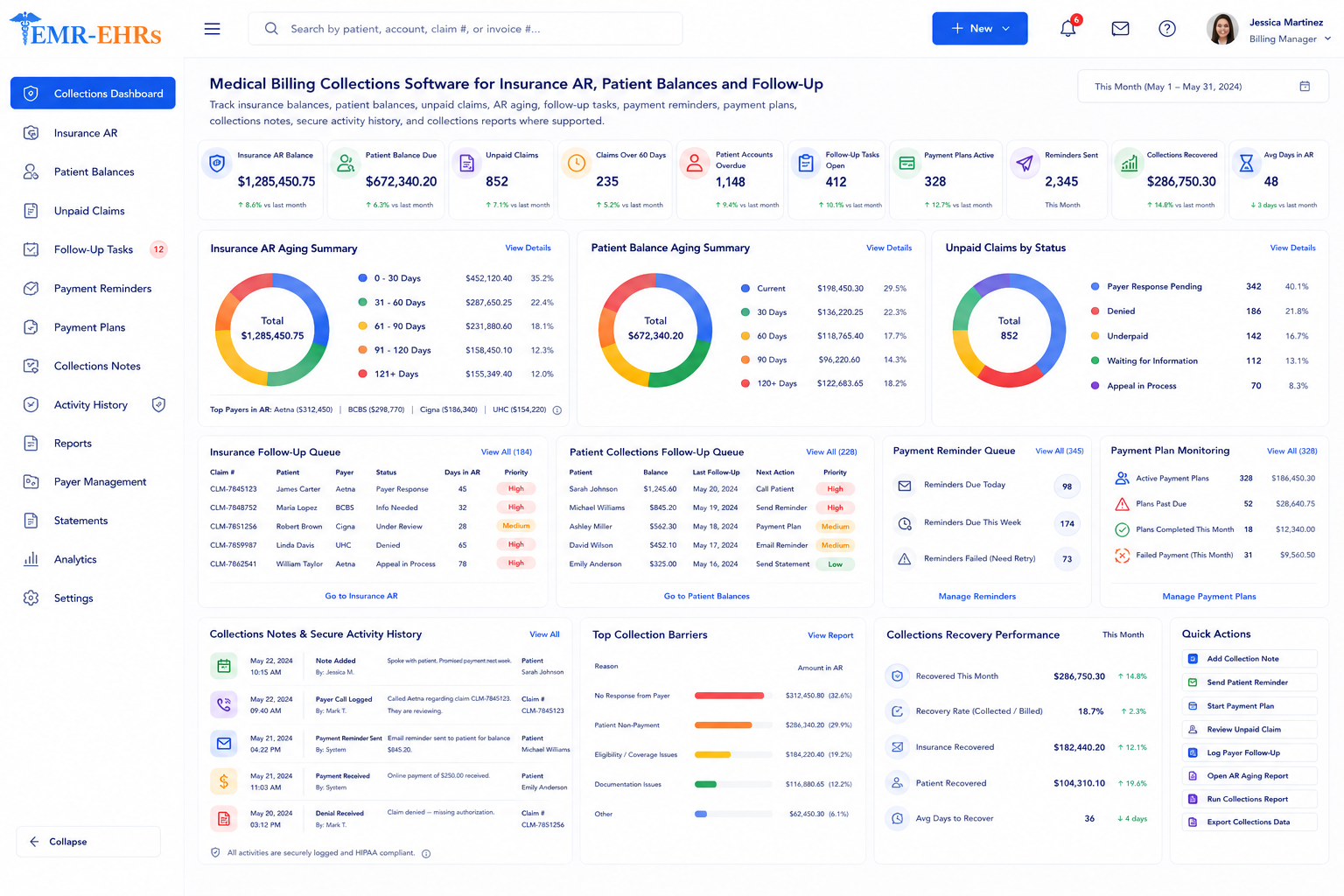
Medical billing collections software helps healthcare practices track, manage, and follow up on unpaid insurance balances, patient balances, claim balances, overdue accounts, payment issues, and collection tasks. It can support insurance AR follow-up, patient AR follow-up, AR aging, unpaid claim worklists, patient statements, payment reminders, payment plans, follow-up notes, reports, and secure collections history where supported.
EMR-EHRs Insurance & Patient Collections Module helps billing teams, RCM teams, front desk staff, and practice managers manage insurance AR, patient balances, unpaid claims, patient responsibility, collections worklists, AR aging, follow-up notes, payment reminders, payment plans, reports, and secure collections history where supported.
Healthcare practices need a connected collections workflow because insurance AR, patient balances, unpaid claims, statements, reminders, payment plans, follow-up notes, and AR aging often become scattered across separate systems or manual tracking files.
Insurance AR and patient AR require different communication steps, timelines, statuses, notes, and staff ownership.
Unpaid claims may remain unresolved when payer follow-up, denial tasks, documentation requests, or staff owners are not clearly tracked.
After insurance payments are posted, deductibles, copays, coinsurance, and remaining balances need clear patient balance follow-up where supported.
Billing teams need aging buckets such as 0-30, 31-60, 61-90, 91-120, and 120+ days to prioritize collections.
Denied claims, partial payments, payer delays, underpayments, and missing documentation need worklists where supported.
Patients need clear balance communication, statement status, statement history, due dates, and payment instructions where supported.
Collections become harder when payment reminders are manual, inconsistent, or not connected to the patient account.
Practices may need to track installment amounts, remaining balances, missed installments, plan status, and follow-up tasks where supported.
Staff may need patient balance visibility during scheduling, check-in, check-out, and billing workflows where supported.
Payer calls, patient calls, promise-to-pay notes, dispute notes, statement notes, and next action dates should stay connected to the balance.
Balances may require adjustment review, write-off review, credit balance review, refund review, hardship notes, or collections hold workflows where supported.
Collections tasks need assigned owners, priorities, due dates, next action dates, and completion statuses where supported.
Practice leaders need insurance AR reports, patient AR reports, aging reports, worklist reports, staff productivity reports, and balance resolution reports.
Patient-facing collection workflows should support clear, respectful balance communication and documented follow-up.
Collections workflows include patient financial information, insurance details, claim data, payment notes, payer responses, balance notes, and staff activity.
Staff identifies an unpaid claim, open balance, patient balance, insurance balance, or AR worklist item.
The balance is categorized as insurance balance, patient balance, secondary balance, denial, underpayment, overpayment, credit, or collections hold where supported.
Staff reviews balance age, service date, claim date, statement date, last payment date, last follow-up date, next follow-up date, and aging bucket where supported.
Billing teams follow up on unpaid claims, payer delays, denials, missing documentation, appeal tasks, or underpayment issues where supported.
Staff reviews deductible, copay, coinsurance, self-pay balance, patient balance, transferred balance, and remaining responsibility where supported.
Staff manages statements, reminders, payment conversations, payment plans, patient communication notes, and balance status where supported.
Tasks are assigned to billing users, RCM staff, front desk teams, managers, or collection owners where supported.
Staff adds payer notes, patient notes, promise-to-pay notes, dispute notes, documentation request notes, statement notes, or reminder notes where supported.
Balances can be marked open, pending, in follow-up, statement sent, reminder sent, payment plan active, disputed, appeal pending, write-off review, collections hold, or closed where supported.
Staff reviews payments, adjustments, contractual amounts, write-offs, credit balances, refunds, or transferred balances where supported.
Collections history, staff activity, balance changes, notes, reminders, statements, payment plan history, and follow-up records are stored where supported.
Managers review insurance AR, patient AR, unpaid claims, AR aging, balance recovery, staff activity, payer trends, and patient balance trends.
Confirm support for automated claim status checks, denial automation, appeals automation, payer response automation, or underpayment detection, including configuration and implementation requirements, during evaluation.
Confirm support for patient balance estimation, automated payment collection, payment plans, patient portal payments, stored cards, or recurring payments, including configuration and implementation requirements, during evaluation.
Confirm support for denial detection, CARC/RARC automation, underpayment detection, contract validation, or appeal automation, including configuration and implementation requirements, during evaluation.
Confirm support for statement automation, patient portal statements, email/SMS statements, or automated patient messaging, including configuration and implementation requirements, during evaluation.
Confirm support for automated reminders, SMS, email, phone automation, or escalation rules, including configuration and implementation requirements, during evaluation.
Confirm support for online payments, portal payments, card-on-file, stored payment method, autopay, recurring payments, or payment plan automation, including configuration and implementation requirements, during evaluation.
Confirm support for automatic write-offs, bad debt transfer, collections agency workflows, hardship processing, or refund automation, including configuration and implementation requirements, during evaluation.
Confirm support for automatic payment posting, ERA/EOB automation, payment reconciliation, or automatic balance transfer, including configuration and implementation requirements, during evaluation.
Confirm support for point-of-service collection prompts, check-in balance alerts, check-out payment collection, or patient-facing payment workflows, including configuration and implementation requirements, during evaluation.
HIPAA-focused collections workflow, designed to support secure patient billing data access, audit-friendly collections records, and role-based collections permissions.
Confirm support for specific payment processors, clearinghouses, payer networks, patient portal payment tools, APIs, HL7/FHIR, payment integrations, SMS/email vendors, or external collection agency workflows, including connection method and implementation scope, during evaluation.
AI-powered collections tools should support staff review and workflow efficiency while billing teams, RCM teams, front desk staff, and practice managers remain responsible for final payer follow-up, patient communication, balance review, payment decisions, write-off review, and collections actions.
Summarize insurance AR, patient AR, aging, balance status, and follow-up context where available.
Help prioritize high-balance accounts, older balances, denials, underpayments, and next actions.
Support follow-up note summaries, payment plan summaries, and collections report review.
Track insurance balances, patient balances, unpaid claims, payment issues, statements, payment plans, follow-up notes, and collections readiness where supported.
Manage insurance AR, patient AR, denials, underpayments, unpaid claims, aging buckets, and balance recovery workflows where supported.
Review patient balances, payment notes, reminder tasks, and balance communication during scheduling, check-in, or check-out where supported.
Monitor AR aging, collections performance, staff productivity, unresolved balances, write-off reviews, payer trends, and patient balance trends.
View balance-related tasks, documentation requests, or payer follow-up items where supported.
Track balances, AR aging, collections status, and staff worklists across locations where supported.
Manage specialty-specific balance follow-up, procedure-related balances, payment plans, and payer collections where supported.
Manage collections permissions, workflow setup, balance categories, reports, users, and audit-friendly activity where supported.
| Workflow Area | Manual Collections Tracking | EMR-EHRs Collections Module |
|---|---|---|
| Insurance AR | Spreadsheets and payer notes | Insurance AR worklists where supported |
| Patient AR | Manual balance lists | Patient balance tracking where supported |
| AR aging | Manual reports | Aging dashboard where supported |
| Follow-up tasks | Sticky notes or reminders | Collections worklists where supported |
| Statements | Manual tracking | Statement workflow where supported |
| Payment reminders | Inconsistent follow-up | Reminder tracking where supported |
| Payment plans | Separate notes | Payment plan tracking where supported |
| Denial follow-up | Separate billing queue | Denial follow-up worklists where supported |
| Balance notes | Scattered records | Secure collections notes |
| Staff ownership | Unclear accountability | Assigned owner and due dates where supported |
| Reports | Manual spreadsheet review | Collections and AR reports |
| Security | Shared files | Role-based access and audit-friendly history |
This conceptual workflow preview illustrates a insurance and patient collections dashboard mockup.
Outstanding balances and balance status.
Tasks, next action dates and staff owners.
Statement and reminder status where supported.
Collections review support where available.
EMR-EHRs helps practices manage insurance balances, patient balances, unpaid claims, and collection tasks in one connected workflow where supported.
EMR-EHRs supports separate views for insurance AR, patient AR, unpaid claims, aging buckets, and balance status where supported.
EMR-EHRs helps teams assign follow-up tasks, track due dates, add notes, monitor statuses, and resolve balances where supported.
EMR-EHRs can support statement tracking, reminder tracking, balance communication, and payment follow-up where available.
EMR-EHRs can support patient balance tracking, payment plan notes, installment status, and payment follow-up where available.
EMR-EHRs supports role-based access, secure billing notes, follow-up history, balance changes, and audit-friendly collections records where supported.
EMR-EHRs can support AR summaries, balance prioritization, follow-up summaries, and collections worklist insights where available.
EMR-EHRs helps configure collections workflows, balance statuses, AR reports, user roles, worklists, and staff training.
Review insurance AR, patient AR, unpaid claims, patient balances, statements, payment reminders, payment plans, write-off reviews, staff ownership, and follow-up processes.
Configure insurance balances, patient balances, secondary balances, claim balances, credits, overpayments, adjustments, and balance categories where supported.
Configure aging buckets, balance age, claim age, statement age, high-balance rules, priority statuses, and staff assignment where supported.
Configure unpaid claim follow-up, payer notes, denial follow-up if supported, underpayment review if supported, appeal tasks if supported, and payer worklists.
Configure patient balance tracking, statement statuses if supported, reminder statuses if supported, promise-to-pay notes if supported, dispute notes, and payment plan statuses if supported.
Configure insurance collections worklists, patient collections worklists, task owners, priorities, due dates, next action dates, and completion statuses.
Configure payment posting connection, balance transfers, remaining balances, patient responsibility, credits, and AR aging updates where supported.
Configure balance alerts, check-in balance visibility, check-out balance review, staff permissions, and patient communication notes where supported.
Configure insurance AR reports, patient AR reports, aging reports, collections activity reports, staff productivity reports, payer balance reports, and provider/location reports.
Configure billing access, front desk access, manager access, payment note permissions, write-off permissions, report permissions, and audit-friendly history.
Configure AI balance summaries, aging summaries, follow-up summaries, payment plan summaries, worklist summaries, and report summaries where available.
Train billing teams, RCM teams, front desk staff, practice managers, providers, and administrators.
Monitor AR aging, unpaid claims, patient balances, follow-up completion, statement activity, payment plans, write-off reviews, and collections reports.
Medical billing collections software helps healthcare practices track and follow up on unpaid insurance balances, patient balances, claim balances, overdue accounts, and collection tasks. EMR-EHRs Insurance & Patient Collections Module can support insurance AR follow-up, patient AR follow-up, AR aging, unpaid claim worklists, payment reminders, payment plans, reports, and secure collections history where supported.
EMR-EHRs helps billing teams manage insurance balances, patient balances, unpaid claims, follow-up tasks, AR aging, staff ownership, collections notes, balance statuses, and reporting where supported. The workflow helps separate insurance AR from patient AR so teams can manage payer follow-up and patient balance follow-up more clearly.
Yes, where supported. EMR-EHRs Insurance & Patient Collections Module can help track patient responsibility, copays, deductibles, coinsurance, self-pay balances, outstanding patient balances, statement status, reminder status, payment plan status, promise-to-pay notes, dispute notes, and collection follow-up history.
EMR-EHRs can help prioritize AR follow-up using insurance AR, patient AR, aging buckets, balance age, claim age, statement age, high-balance accounts, oldest balances, last follow-up date, next action date, staff owner, and collections worklists where supported. This helps billing teams focus on the balances that need attention first.
Practices should use integrated collections software because spreadsheets often create disconnected balance lists, scattered notes, unclear staff ownership, missed follow-ups, and limited reporting. EMR-EHRs Insurance & Patient Collections Module supports connected AR tracking, insurance and patient balance separation, collections worklists, follow-up notes, secure history, reports, and audit-friendly records where supported.
Track insurance balances, patient balances, unpaid claims, AR aging, follow-up tasks, payment reminders, payment plans, collections notes, and reporting with EMR-EHRs Insurance & Patient Collections Module where supported.
Phone: (480) 782-1116 | Email: jason@1stproviderschoice.com