Physical therapy EMR software

Physical Therapy EMR Software for Documentation, Billing & Practice Management

Purpose-built physical therapy EMR software to help PT clinics document faster, manage treatment plans, track outcomes, schedule visits, manage referrals and authorizations, streamline billing, and run daily practice operations from one connected system.
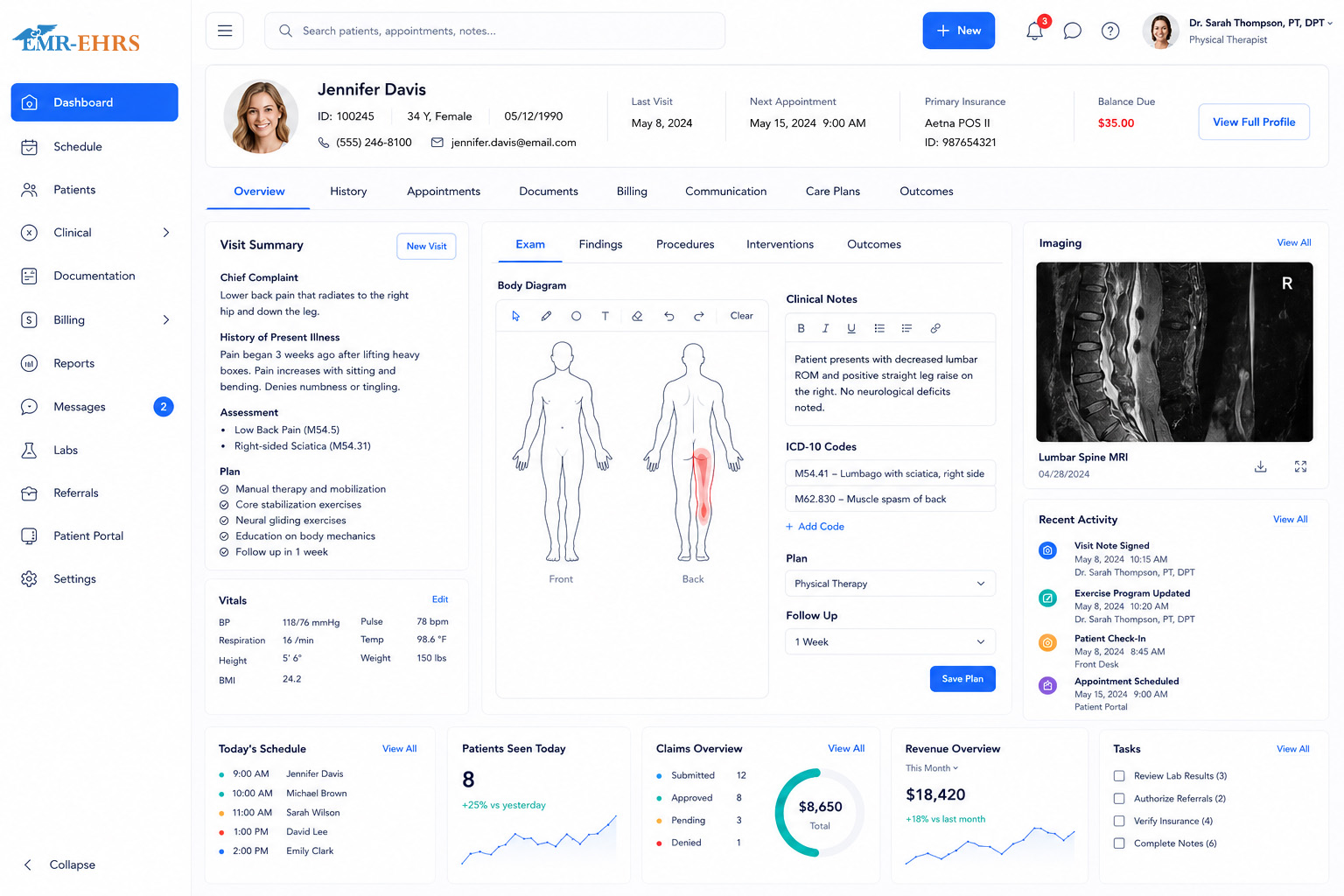
Physical Therapy EMR dashboard preview
PT Documentation Templates Billing & Claims Authorization Tracking Outcome Reporting HIPAA-Focused Workflows Training & Support
Best answer

What Is Physical Therapy EMR Software?

Physical therapy EMR software is a digital system that helps physical therapists manage patient records, evaluations, SOAP notes, treatment plans, progress notes, outcome measures, scheduling, billing, referrals, authorizations, and practice management in one connected workflow.

The best physical therapy EMR software should help therapists document faster, support payer and compliance documentation, track patient progress, reduce billing errors, manage authorizations, and improve clinic visibility from intake to discharge.

Why Physical Therapy Practices Need Specialty-Specific EMR Software

Generic medical EMRs are often not built around rehab therapy workflows. Physical therapy clinics need software that supports evaluations, treatment plans, time-based services, functional goals, progress tracking, referrals, authorizations, and therapy-specific billing.

After-Hours Documentation

Therapists lose time completing notes after visits.

Generic Templates

Standard EMR forms do not match PT evaluation, SOAP note, and progress note workflows.

Incomplete Documentation

Missing signatures, plan-of-care details, medical necessity, or visit history can create audit and payer risk.

Weak Outcome Visibility

Clinics need to track goals, function, pain, ROM, strength, and progress across the episode of care.

Authorization Problems

Missed visit limits, expired authorizations, and missing referrals can delay payment.

Billing Delays

Incomplete documentation, coding errors, and claim rework slow revenue.

Front Desk Overload

Manual intake, reminders, appointment changes, and insurance collection create extra work.

Poor Practice Visibility

Owners need reporting for visits, productivity, claims, cancellations, authorizations, and revenue.

Physical Therapy Documentation Built for Rehab Workflows

APTA documentation guidance identifies core documentation elements such as initial examination/evaluation, visit documentation, reexamination, and conclusion-of-episode summaries.

Initial Evaluation Templates

  • Patient history
  • Diagnosis and condition details
  • Pain level
  • Functional limitations
  • Range of motion
  • Strength
  • Mobility
  • Objective findings
  • Clinical assessment
  • Plan of care
  • Treatment goals
  • Frequency and duration
  • Therapist signature

Daily SOAP Notes

  • Subjective update
  • Objective treatment performed
  • Timed service details
  • Patient response
  • Assessment
  • Plan
  • Therapist notes
  • Signature/authentication
  • Documentation completion status

Progress Notes & Re-Evaluations

  • Goal progress
  • Updated findings
  • Treatment response
  • Functional improvement
  • Continued medical necessity
  • Updated plan of care
  • Remaining limitations
  • Provider/payer communication

Discharge Summaries

  • Completed goals
  • Final patient status
  • Functional outcomes
  • Treatment summary
  • Home exercise or follow-up recommendations
  • Discharge reason
  • Future care instructions

Custom PT Templates

  • Orthopedic physical therapy
  • Sports rehabilitation
  • Pediatric physical therapy
  • Neurological rehab
  • Pelvic health PT
  • Vestibular therapy
  • Post-surgical rehab
  • Workers compensation cases
  • Medicare patients
  • Multi-provider PT clinics

Track Patient Progress, Goals & Functional Outcomes

Physical therapy care is built around measurable improvement from evaluation through every visit, progress report, re-evaluation, and discharge summary.

Functional outcome tracking
Goal status and goal achievement
Pain score tracking
ROM progress
Strength and mobility progress
Patient-reported outcome measures
Progress comparison across visits
Treatment response history
Discharge readiness indicators
Outcome reporting for providers and payers

Outcome Snapshot

72%Goal progress

Pain score trend, ROM improvement, completed visits, remaining visits, and discharge readiness in one view.

Digital Patient Intake That Flows Into PT Documentation

Digital intake helps reduce front-desk work and gives therapists cleaner patient information before the first visit.

Online intake forms
Patient demographics
Insurance information
Medical history
Consent forms
Referral information
Injury or condition details
Pain and function questionnaires
Patient-reported outcome forms
Pre-visit form completion status
Intake data connected to evaluation notes

Reduce duplicate data entry before the first appointment starts.

Referral, Authorization & Visit Limit Tracking

For physical therapy clinics, missed referrals, expired authorizations, and used-up visit limits can lead to delayed or denied claims. Your EMR should make this information visible before the patient arrives.

Referral source tracking
Referring provider details
Authorization start date
Authorization expiration date
Approved visit count
Remaining visit count
Payer rules
Insurance limitations
Medicare tracking where applicable
Missing authorization alerts
Expiring authorization alerts
Scheduler-level visibility
Billing team visibility
Documentation connected to authorization requirements

Authorization tracking is one of the most important PT revenue workflows.

All-in-One Physical Therapy Practice Management Software

Use one connected system to manage clinical, administrative, and financial workflows across your PT practice.

Patient records
Appointment scheduling
Staff/provider scheduling
Intake forms
Documentation
Billing
Claims
Referrals
Authorizations
Patient balances
Reports
Task management
Patient communication
Multi-provider workflow
Multi-location support if available

This section supports physical therapy practice management software search intent.

Patient Engagement Tools for a Better PT Clinic Experience

Better patient engagement helps reduce missed visits, improve preparedness, and support a smoother therapy experience.

Digital intake forms
Appointment reminders
Patient communication
Visit preparation instructions
Patient balance notifications
Follow-up reminders
Patient portal access if available
Faster check-in
Reduced paperwork
Improved patient communication between visits

Digital communication makes recurring therapy visits easier for patients and staff.

Integrations That Connect Your Physical Therapy Workflow

PT clinics often need to connect documentation, referrals, billing, patient communication, and reporting with other tools.

Clearinghouse/electronic claims integration
Billing and RCM tools
Patient portal
Appointment reminders
Payment tools
Document management
Referral workflow
EHR data exchange where applicable
Hospital/post-acute EHR connection where applicable
Secure records exchange
Data migration support
EMR hosting/server support if relevant

Support connected workflows across clinical, administrative, and financial systems.

Physical Therapy Scheduling for Busy Clinics

PT practices need scheduling tools that support recurring visits, provider availability, treatment rooms, patient reminders, copays, visit limits, and authorization visibility.

Appointment Scheduling

  • Daily, weekly, and monthly calendar views
  • Drag-and-drop rescheduling
  • Recurring appointment scheduling
  • Provider scheduling
  • Room/resource scheduling
  • Appointment status
  • Cancellation/no-show tracking
  • Waitlist support if available

Scheduler-Level Alerts

  • Missing referral alert
  • Authorization status alert
  • Remaining visits warning
  • Expiring authorization warning
  • Patient balance alert
  • Copay reminder
  • Missing intake form alert
  • Unsigned documentation alert

Appointment Reminders

  • Automated reminders
  • Confirmation tracking
  • Reduced no-shows
  • Front-desk workflow support

Physical Therapy Billing & Revenue Cycle Management

Physical therapy billing works best when documentation, coding, authorizations, claim submission, payment tracking, and reporting are connected in one workflow.


Therapy-Specific Billing Support

  • CPT code support
  • ICD-10 diagnosis support
  • Timed service units
  • Modifiers
  • Fee schedules
  • Copays
  • Patient balances
  • Insurance limitations
  • Medicare-related tracking where applicable

Claim Preparation & Clean Claims

  • Documentation-to-billing connection
  • Missing information checks
  • Claim readiness indicators
  • Claim scrubbing/pre-claim review
  • CMS-1500 support
  • Electronic claim submission
  • Batch claim status

Denials, Payments & Unpaid Claims

  • Rejected claim tracking
  • Denial tracking
  • ERA/payment posting
  • Collections workflow
  • Unpaid claim reports
  • Aging reports
  • Revenue visibility
  • Billing team worklists

RCM Reporting

  • Claims by payer
  • Denials by reason
  • Unpaid claims
  • A/R aging
  • Collections performance
  • Payment trends
  • Revenue by provider/location
  • Billing productivity

HIPAA-Compliant, Secure, and Built for Healthcare Trust

AI-Powered Tools to Reduce PT Documentation and Admin Work

AI is positioned as a workflow assistant, not as a replacement for therapist review or clinical judgment.

AI Documentation Assistance

Draft note content, summarize visit details, and reduce repetitive text entry.

Smart SOAP Note Prompts

Suggest missing note elements based on visit type or documentation pattern.

Patient Progress Summaries

Summarize changes across visits, goals, and outcomes.

Billing Risk Alerts

Flag missing documentation, incomplete charges, or claim-risk items before submission.

Authorization Alerts

Identify expiring authorizations, remaining visit limits, and missing referral details.

Scheduling Insights

Highlight no-shows, open appointment gaps, and patient follow-up opportunities.

Task Prioritization

Surface unsigned notes, incomplete intake forms, pending claims, and admin tasks.

Trust note

AI features should support staff efficiency while keeping therapists in control of clinical review and final documentation.

PT Practice Reporting and Performance Visibility

Clinic owners, administrators, therapists, and billing teams need visibility into clinical, operational, and financial performance.

Clinical Reports

  • Outcome reports
  • Goal progress reports
  • Completed visits
  • Plan-of-care status
  • Discharge readiness
  • Documentation completion

Operational Reports

  • Appointment volume
  • No-shows/cancellations
  • Provider productivity
  • Referral source performance
  • Authorization status
  • Patient volume trends

Financial Reports

  • Claims submitted
  • Claims pending
  • Denials
  • Unpaid claims
  • A/R aging
  • Collections
  • Revenue by provider/location/payer

Built for Physical Therapy and Rehab Practices

Private Physical Therapy Clinics

Documentation, scheduling, billing, and patient workflow in one system.

Orthopedic PT Practices

Templates for pain, mobility, ROM, strength, and post-surgical rehab.

Sports Rehabilitation Clinics

Progress tracking, treatment plans, outcomes, and return-to-activity workflows.

Pediatric Physical Therapy Clinics

Pediatric-friendly templates, progress tracking, and family communication support.

Neurological Rehab Practices

Support for complex treatment plans and ongoing functional progress tracking.

Pelvic Health PT Clinics

Specialty templates and private, secure documentation workflows.

Vestibular Therapy Clinics

Visit notes, progress tracking, and therapy-specific documentation support.

Multi-Provider PT Groups

Scheduling, reporting, documentation, and billing visibility across providers.

Multi-Location Rehab Organizations

Standardized workflows, reporting, and operational visibility across locations.

PT, OT, and SLP Therapy Practices

Rehab therapy workflows for multi-disciplinary teams where applicable.

Physical Therapy EMR vs Generic EMR

Workflow AreaGeneric EMRPhysical Therapy EMR
DocumentationGeneral medical note templatesPT evaluations, SOAP notes, progress notes, re-evaluations, discharge summaries
Treatment PlansBasic care plan fieldsGoals, frequency, duration, interventions, exercises, and progress tracking
Outcome TrackingOften limitedFunctional outcomes, pain, ROM, strength, mobility, and goal progress
SchedulingBasic appointment calendarRecurring visits, provider/resource scheduling, reminders, and visit-limit alerts
ReferralsOften manualReferral source, status, and documentation visibility
AuthorizationsOften separate/manualApproved visits, remaining visits, expiration dates, and payer alerts
BillingGeneral billing workflowTherapy codes, timed units, modifiers, payer rules, claims, and denials
ComplianceGeneral record storagePlan of care, medical necessity, signed notes, payer documentation, audit support
ReportingGeneral reportsOutcomes, productivity, authorizations, claims, referrals, and revenue visibility

Physical Therapy EMR vs EHR: What Should Your Clinic Choose?

For most physical therapy clinics, the practical goal is not the label EMR or EHR. The priority is choosing a system that supports PT documentation, patient records, interoperability, scheduling, billing, authorizations, patient engagement, reporting, and secure clinical workflows.

TermMeaning for PT Clinics
EMRDigital patient chart and clinical documentation inside one practice
EHRBroader electronic health record that may support sharing information across providers or care settings
PT Practice Management SoftwareAdministrative and financial workflows such as scheduling, billing, claims, reminders, and reporting
Best OptionA connected PT EMR/EHR + practice management system

What to Look for in the Best Physical Therapy EMR Software

Use this checklist when comparing PT EMR vendors.

PT evaluation templates
Daily SOAP notes
Progress notes and re-evaluations
Discharge summaries
Treatment plans and plan-of-care support
Goal and outcome tracking
Pain, ROM, strength, and mobility tracking
Digital patient intake
Patient-reported outcome forms
Scheduling and appointment reminders
Referral tracking
Authorization and visit limit tracking
CPT, ICD-10, modifier, and timed unit support
Claim scrubbing and electronic claims
Denial and unpaid claim tracking
Patient balances and payment visibility
Compliance-focused documentation
Role-based access and secure patient records
Patient portal/communication tools
Reporting and analytics
AI documentation assistance
Integrations and data migration
Training, onboarding, and support

See the Physical Therapy EMR Workflow in Action

A product-style workflow preview gives buyers a clear view of how documentation, outcomes, billing, authorizations, and AI assistance fit together.

Today's PT WorkflowClaim readiness 92%
Selected patient chart
Emma Clark
SOAP note editor
Timed units ready
Treatment plan
12 visits approved
Goal tracker
72% complete
Outcome graph
ROM +18 degrees
AI note assistant
2 items to review
Auth expires in 9 daysRemaining visits: 5Missing signature alertUnsigned notes: 4Claims ready: 18Unpaid claims: 12

Why Choose EMR-EHRS for Physical Therapy EMR Software?

Specialty Workflow Support

Built to support physical therapy documentation, scheduling, billing, authorizations, referrals, and reporting.

Connected EMR + Practice Management

Clinical and administrative workflows connected in one system.

Billing and Claims Visibility

Tools to support fee schedules, claims, unpaid claims, patient balances, and reporting.

Implementation and Training

Support for setup, templates, staff training, workflow configuration, and go-live.

Secure Patient Record Workflows

HIPAA-focused workflows, role-based access, and secure documentation support.

Support from EMR Experts

Phone: (480) 782-1116. Email: info@emr-ehrs.com. Support hours: Monday-Friday, 9 AM-6 PM MST.

Implementation, Training & Support for Your PT Practice

1

Discovery Call

Understand clinic size, specialties, billing needs, and workflow.

2

System Setup

Configure templates, users, schedules, billing settings, and reports.

3

Training

Train therapists, front desk, billing staff, and administrators.

4

Go-Live Support

Support your team during launch.

5

Ongoing Optimization

Improve templates, reports, and workflow over time.

Physical Therapy EMR Software FAQs

Physical therapy EMR software helps PT clinics manage patient records, evaluations, SOAP notes, treatment plans, progress notes, outcome tracking, scheduling, billing, referrals, authorizations, and reporting in one connected system.
A physical therapy EMR should include PT-specific templates, SOAP notes, progress notes, treatment plans, outcome tracking, digital intake, scheduling, authorization tracking, billing, claims management, patient communication, reporting, and secure patient records.
It helps therapists document evaluations, daily visits, treatment plans, progress notes, re-evaluations, and discharge summaries using structured PT templates. It can also support signatures, documentation completion alerts, medical necessity details, and outcome tracking.
PT EMR software can connect documentation with billing workflows, support CPT and ICD-10 coding, track authorizations and visit limits, identify missing claim information, manage unpaid claims, and give billing teams visibility into claim status and payer requirements.
A specialty-specific physical therapy EMR is designed around rehab workflows such as evaluations, SOAP notes, treatment plans, outcome tracking, authorizations, timed services, progress notes, and therapy billing. A generic EMR often requires more manual customization.

Ready to Improve Your Physical Therapy Workflow?

Simplify PT documentation, scheduling, billing, authorizations, referrals, patient intake, outcome tracking, and practice management with physical therapy EMR software built for rehab-focused clinics.

Phone: (480) 782-1116   Email: info@emr-ehrs.com