Occupational Therapy EHR Software

Occupational Therapy EHR Software for OT Clinics & Therapy Practices

EMR-EHRs Occupational Therapy EHR Software helps therapy teams manage evaluations, treatment plans, visit notes, goals, progress tracking, authorizations, scheduling, billing, and secure records in one connected workflow.
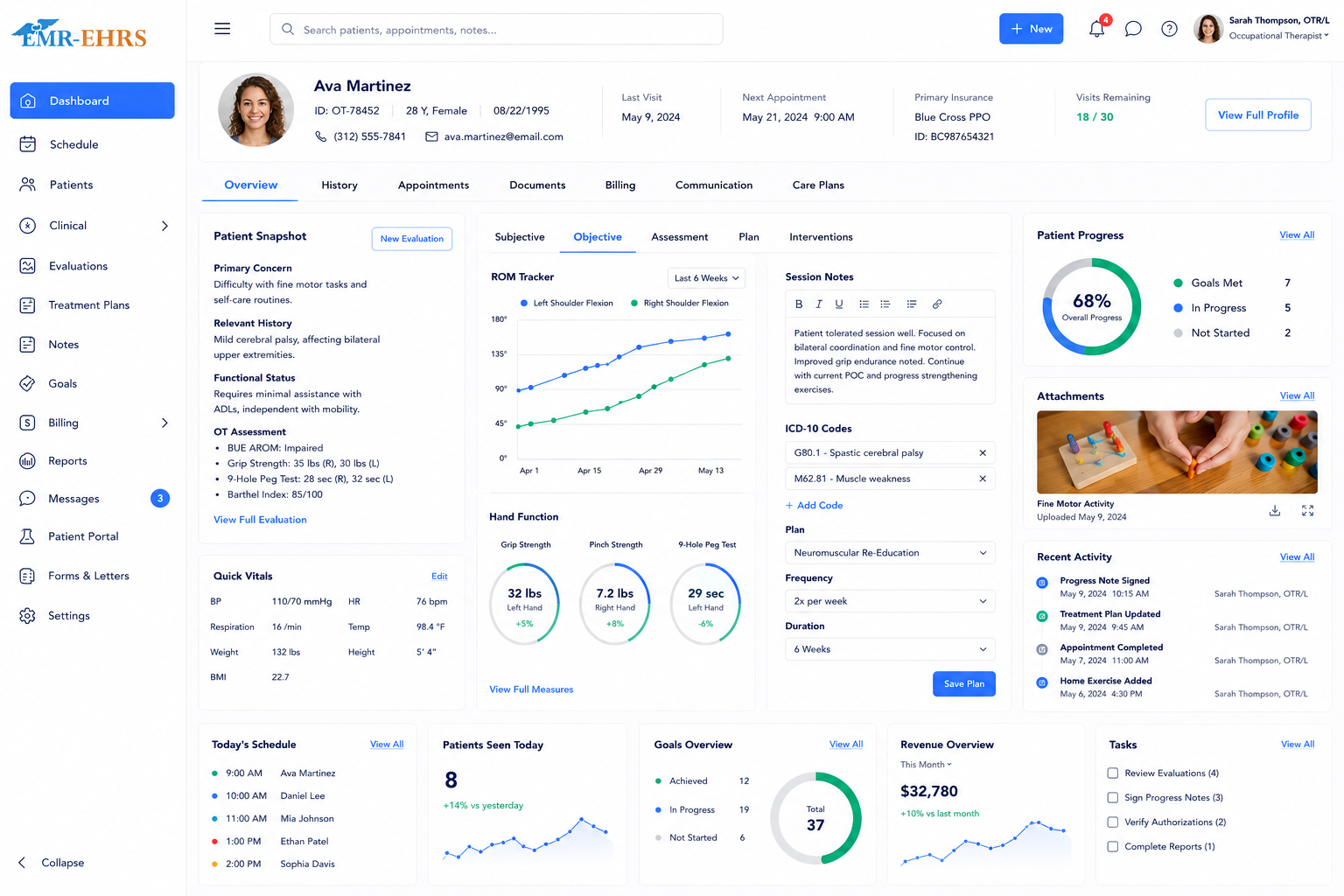
Occupational Therapy EHR dashboard preview
OT EvaluationsADL/IADL DocumentationSOAP NotesGoal TrackingAuthorizationsOT BillingPatient Portal
Quick answer

What Is Occupational Therapy EHR Software?

Occupational therapy EHR software is a specialty electronic health record system that helps OT practices manage patient records, referrals, intake forms, occupational profiles, evaluations, ADL/IADL documentation, treatment plans, SOAP notes, daily treatment notes, functional goals, progress tracking, authorizations, visit limits, billing, scheduling, patient portal access, reporting, and discharge documentation.

EMR-EHRs occupational therapy EHR software supports the full OT workflow: referral, intake, occupational profile, initial evaluation, ADL/IADL assessment, plan of care, goal setting, treatment documentation, progress tracking, authorization management, billing, reporting, patient engagement, and discharge.

Why Occupational Therapy Practices Need Specialty-Specific EHR Software

Occupational therapy practices manage functional evaluations, occupational profiles, treatment goals, ADL/IADL progress, therapy notes, payer authorizations, visit limits, referrals, billing, patient communication, caregiver education, and long-term outcomes. A generic EHR often does not provide enough structure for OT-specific documentation, skilled therapy justification, goal progress, therapy billing, and discharge reporting.

Time-Consuming OT Documentation

OT providers need fast templates for evaluations, SOAP notes, daily treatment notes, progress notes, reassessments, treatment plans, and discharge summaries.

Weak ADL/IADL and Functional Goal Tracking

Therapy teams need to track daily living skills, functional limitations, short-term goals, long-term goals, treatment response, and measurable outcomes.

Disconnected Referral, Authorization and Visit Limit Tracking

OT practices need to track referrals, eligibility, authorized visits, visits used, visits remaining, expiration dates, payer rules, and recertification needs.

Limited Patient Progress Visibility

Therapists need quick access to baseline function, current status, goal progress, outcome measures, functional improvement, and discharge readiness.

Complex OT Billing and Timed Unit Requirements

OT billing often depends on accurate documentation, CPT codes, timed units, modifiers, payer rules, claim readiness, and denial tracking.

Different OT Specialty Workflows

Pediatric OT, adult rehab, hand therapy, neuro rehab, geriatric therapy, and work conditioning require different templates and goal structures.

Patient and Caregiver Communication Gaps

Patients and caregivers need home programs, care plans, education, reminders, portal messaging, and follow-up instructions.

Multi-Provider Coordination Challenges

OT clinics may need shared records across occupational therapists, assistants, front desk staff, billing teams, and multiple locations.

Limited Reporting for Therapy Operations

Practices need reports for visits, cancellations, productivity, authorizations, outcomes, claims, denials, revenue, and provider performance.

Manage the Full OT Care Journey From Intake to Discharge

1

Patient Intake and Referral

Capture demographics, insurance, referral source, diagnosis, reason for therapy, prior records, precautions, medical history, consent forms, and payer requirements.

2

Occupational Profile

Document patient priorities, daily routines, roles, responsibilities, home environment, work or school needs, caregiver support, barriers to participation, safety concerns, and patient goals.

3

Initial OT Evaluation

Document current functional status, prior level of function, ADLs, IADLs, ROM, strength, coordination, cognition, sensory needs, pain, mobility, home environment, equipment needs, and therapist assessment.

4

ADL/IADL and Functional Assessment

Track feeding, grooming, bathing, dressing, toileting, transfers, meal preparation, home management, community mobility, medication management, work participation, school participation, and safety awareness.

5

Goal Setting

Create measurable short-term and long-term goals tied to independence, participation, safety, self-care, work, school, home activities, and functional outcomes.

6

Plan of Care

Define treatment frequency, duration, interventions, skilled therapy rationale, functional limitations, patient/caregiver education, home program, equipment needs, and discharge planning.

7

Daily Treatment Notes

Document skilled interventions, therapeutic activities, therapeutic exercises, self-care training, neuromuscular re-education, manual therapy, orthotic training, patient response, and education.

8

SOAP Documentation

Document subjective report, objective treatment details, assessment of progress, plan for next session, goal progress, functional changes, and skilled therapy justification.

9

Authorization and Visit-Limit Tracking

Track authorized visits, visits used, visits remaining, authorization expiration, referral requirements, payer rules, and continued care documentation.

10

Progress Note and Reassessment

Compare baseline function, current function, goal status, outcome measures, treatment response, remaining limitations, updated plan of care, and continued therapy needs.

11

Patient and Caregiver Engagement

Share home programs, care plans, patient education, caregiver instructions, appointment reminders, portal messages, and follow-up guidance.

12

Billing and Claims

Connect documentation, CPT codes, ICD-10 codes, timed units, modifiers, authorizations, visit limits, claim readiness, electronic claims, denials, payments, and unpaid claims.

13

Discharge Summary and Outcome Reporting

Document discharge reason, goals met, functional status at discharge, outcome measures, home program, equipment recommendations, referrals, and final outcome summary.

Occupational Therapy Documentation Templates Built for OT Workflows

Initial Evaluation Templates

  • Referral reason
  • Diagnosis
  • Medical history
  • Occupational profile
  • Prior level of function
  • Current functional status
  • ADL assessment
  • IADL assessment
  • Range of motion
  • Strength
  • Grip strength
  • Pinch strength
  • Fine motor coordination
  • Gross motor coordination
  • Balance
  • Cognition
  • Sensory processing
  • Pain level
  • Home environment
  • School environment if applicable
  • Work-related needs
  • Assistive device needs
  • Therapist assessment
  • Plan of care

SOAP Note Templates

  • Subjective report
  • Objective treatment details
  • Assessment of progress
  • Plan for next session
  • Functional changes
  • Goal progress
  • Skilled therapy justification
  • Patient education
  • Caregiver education

Daily Treatment Note Templates

  • Visit date
  • Treatment time
  • Timed units
  • Skilled interventions
  • Therapeutic activities
  • Therapeutic exercise
  • Self-care/home management training
  • Neuromuscular re-education
  • Manual therapy if applicable
  • Orthotic or splinting support if applicable
  • Patient response
  • Pain response
  • Caregiver education
  • Home program updates
  • Next visit plan

Progress Note Templates

  • Baseline function
  • Current function
  • Goal status
  • Short-term goal progress
  • Long-term goal progress
  • Treatment response
  • Outcome measure updates
  • Continued therapy justification
  • Updated plan of care
  • Recommended frequency and duration

Reassessment Templates

  • Updated functional status
  • Change in ADL/IADL performance
  • Updated measurements
  • Goal modification
  • Barriers to progress
  • Updated treatment plan
  • Authorization support documentation
  • Continued care recommendation

Discharge Summary Templates

  • Discharge reason
  • Goals met
  • Goals partially met
  • Functional status at discharge
  • Outcome measures
  • Home program
  • Equipment recommendations
  • Patient/caregiver education
  • Referral recommendations
  • Final outcome summary

OT Evaluations, Occupational Profiles and Functional Assessments

Patient priorities
Daily routines
Roles and responsibilities
Home environment
Work environment
School environment if applicable
Caregiver support
Barriers to participation
Patient goals
Safety concerns
Feeding
Grooming
Bathing
Dressing
Toileting
Transfers
Meal preparation
Home management
Community mobility
Medication management
Work participation
School participation
Safety awareness
Range of motion
Strength
Grip strength
Pinch strength
Fine motor coordination
Gross motor coordination
Balance
Endurance
Pain
Edema if applicable
Functional mobility
Assistive device use
Attention
Memory
Problem-solving
Executive function
Safety judgment
Sensory processing
Visual-motor integration
Visual perception
Motor planning
Behavioral response if applicable

Plan of Care, Skilled Therapy Justification and Medical Necessity

EMR-EHRs helps occupational therapy providers create structured plans of care that connect treatment interventions, skilled therapy rationale, functional limitations, measurable goals, patient education, and discharge planning.

Therapy frequency
Therapy duration
Treatment interventions
Skilled therapy rationale
Functional limitations
Medical necessity support
Measurable goals
Patient/caregiver education
Home program
Equipment recommendations
Recertification support
Discharge planning
Provider signature workflow if applicable

Track Functional Goals, Patient Progress and Therapy Outcomes

EMR-EHRs helps occupational therapy providers track functional progress across visits, update goals, document skilled therapy, and show measurable improvement from evaluation through discharge.

Short-term goal tracking
Long-term goal tracking
SMART goal structure
Goal status updates
Baseline vs current function
Progress over time
Treatment response
Patient participation
Functional independence tracking
Outcome measure tracking
Caregiver-reported progress
Discharge readiness
Visual progress dashboard

Templates for Pediatric OT, Adult Rehab, Hand Therapy, Neuro Rehab and Work Conditioning

Developmental history
Sensory processing
Fine motor skills
Gross motor skills
Visual-motor skills
Feeding concerns
School participation
Play skills
Self-care skills
Caregiver goals
ADL status
IADL status
Mobility
Strength
Endurance
Cognition
Home safety
Equipment needs
Injury history
Grip strength
Pinch strength
Edema
Scar management
Splinting/orthotic notes
Stroke history
Brain injury history
Visual perception
Functional independence
Fall history
Job demands
Functional capacity
Work simulation tasks
Return-to-work goals

Authorization, Referrals and Visit Limit Tracking for OT Practices

EMR-EHRs helps occupational therapy teams keep referrals, authorizations, visit limits, payer requirements, and recertification needs visible across scheduling, documentation, and billing workflows.

Referral source tracking
Diagnosis and referral reason
Insurance eligibility
Prior authorization status
Authorization number
Approved visits
Visits used
Visits remaining
Authorization start date
Authorization expiration date
Payer documentation requirements
Recertification reminders
Missing documentation alerts
Staff worklists
Scheduler visibility
Billing team visibility

Scheduling for Occupational Therapy Visits, Evaluations and Follow-Ups

New patient scheduling
Evaluation scheduling
Treatment visit scheduling
Reassessment scheduling
Progress note scheduling
Discharge visit scheduling
Recurring therapy appointments
Therapist schedules
Assistant schedules if applicable
Multi-provider scheduling
Multi-location scheduling if available
Room/resource scheduling
Drag-and-drop rescheduling
Waitlist management
No-show/cancellation tracking
Appointment reminders
Authorization alerts
Visit limit alerts
Patient balance alerts
Missing intake alerts

Patient Portal for OT Forms, Care Plans, Home Programs and Communication

Online registration
OT intake forms
Consent forms
Medical history forms
Functional status questionnaires
Home exercise instructions
Care plan access
Appointment requests
Appointment reminders
Secure messaging
Visit summaries
Patient education
Caregiver communication
Insurance information updates
Online bill pay if available
Demographic updates
Reduced phone calls
Better follow-up compliance

Home Programs, Patient Education and Care Coordination

EMR-EHRs helps occupational therapy teams extend care beyond the visit with home programs, caregiver education, safety guidance, adaptive equipment recommendations, and shared care plans.

Home exercise programs
Self-care training instructions
Adaptive equipment guidance
Caregiver education
School recommendations
Work recommendations
Safety education
Fall prevention instructions
Discharge instructions
Interdisciplinary communication
Referring provider communication
Care plan sharing

All-in-One Occupational Therapy Practice Management Software

EMR-EHRs connects clinical, administrative, and financial workflows so occupational therapy practices can manage patient care, documentation, scheduling, authorizations, billing, and reporting without relying on disconnected systems.

Patient records
Digital intake
Scheduling
OT documentation
Treatment plans
Goal tracking
Authorization tracking
Visit limit tracking
Patient portal
Billing
Claims
Reports
Staff tasks
Patient balances
Multi-provider workflow
Multi-location support if available

Billing, Portal and Therapy Workflow Integrations

Only specific integration partners, systems, payers, clearinghouses, or device connections should be listed when verified. This page uses careful workflow wording for connected documentation and exchange needs.

Patient portal integration
Appointment reminder integration
Billing workflow integration
Clearinghouse integration
Payment integration
Referral document management
Document upload and attachment workflow
Data migration
Secure document exchange
Multi-location record access
Reporting data connection
E-prescribing integration if applicable

HIPAA-Focused Occupational Therapy EHR for Secure Patient Records

HIPAA-focused workflows, audit-friendly records, secure patient record management, and design that supports secure documentation.

Role-based access
Password protection
Automatic logout
Access logs
Change logs
Audit-friendly documentation
Secure patient portal
Signed notes
Document history
Secure storage
Backup-friendly workflows
Patient privacy controls
HIPAA-focused workflows
Secure therapy documentation

Occupational Therapy Billing, Claims and Revenue Cycle Management

OT Billing Support

  • Evaluation billing
  • Re-evaluation billing
  • Treatment visit billing
  • Timed unit support
  • CPT code support
  • ICD-10 support
  • Modifier support
  • Fee schedules
  • Payer rules
  • Documentation-to-billing connection

Common OT Billing Workflow Support

  • Initial evaluation coding
  • Re-evaluation coding
  • Therapeutic activity documentation
  • Therapeutic exercise documentation
  • Self-care/home management documentation
  • Neuromuscular re-education documentation
  • Orthotic management/training documentation if applicable
  • Manual therapy documentation if applicable

Claim Readiness and Denial Tracking

  • Claim readiness checks
  • Missing documentation alerts
  • Authorization checks
  • Visit limit checks
  • Electronic claims
  • Batch claim status
  • Rejected claims
  • Denial tracking
  • ERA/payment posting
  • Patient balances
  • Unpaid claims
  • A/R aging
  • Revenue reports

AI-Powered Tools to Reduce OT Documentation and Admin Work

AI-powered tools should support documentation and administrative efficiency while keeping occupational therapists responsible for final review, clinical judgment, treatment decisions, and signed records.

AI visit note assistance

Help draft visit notes while therapists retain final review and signature control.

AI evaluation summary support

Summarize occupational profile, baseline function, measurements, and plan of care details.

AI SOAP note draft support

Support SOAP note drafts based on visit details and skilled interventions.

Goal progress summary assistance

Help summarize short-term and long-term goal progress across visits.

Authorization risk alerts

Highlight visit limit, authorization expiration, and missing documentation risks.

Billing readiness alerts

Flag missing note, timed unit, authorization, or claim readiness gaps.

Occupational Therapy Reports and Practice Performance Visibility

Clinical Reports

  • Evaluation volume
  • Treatment visit volume
  • Goal progress reports
  • Outcome measure reports
  • Progress note status
  • Reassessment status
  • Discharge reports
  • Patient progress trends
  • Functional improvement reports

Operational Reports

  • Appointment volume
  • No-shows/cancellations
  • Therapist productivity
  • Referral source performance
  • Authorization status
  • Visits remaining
  • Pending documentation
  • Staff worklist status
  • Patient portal usage

Financial Reports

  • Claims submitted
  • Claims pending
  • Denials
  • Unpaid claims
  • A/R aging
  • Revenue by therapist
  • Revenue by payer
  • Revenue by location
  • Revenue by service type
  • Patient balance reports

Built for Occupational Therapy Practices and Therapy Teams

Occupational Therapy Clinics

Manage evaluations, treatment notes, goals, scheduling, billing, authorizations, and reporting.

Pediatric OT Practices

Support developmental, sensory, fine motor, gross motor, feeding, self-care, school, and caregiver-focused documentation.

Adult Rehabilitation Clinics

Track ADLs, IADLs, strength, mobility, cognition, functional progress, equipment needs, and treatment response.

Hand Therapy Providers

Document ROM, grip strength, pinch strength, splinting, scar management, pain response, edema, and functional hand use.

Neuro Rehab Teams

Support stroke, brain injury, cognition, coordination, visual perception, ADL retraining, safety, and functional independence workflows.

Geriatric Therapy Providers

Track fall risk, home safety, functional mobility, caregiver needs, cognitive status, and equipment recommendations.

Work Conditioning and Return-to-Work Programs

Manage job demands, functional capacity, work simulation tasks, endurance, restrictions, and return-to-work goals.

Multi-Provider Therapy Groups

Centralize records, therapist schedules, documentation, billing, patient communication, authorizations, and reports.

Multi-Location Therapy Organizations

Manage scheduling, records, reporting, authorizations, billing, and workflows across locations.

Occupational Therapy EHR vs Generic EHR

Workflow AreaGeneric EHROccupational Therapy EHR
OT evaluationsGeneral visit notesOT evaluation templates for occupational profile, ADLs, IADLs, ROM, strength, cognition, function, and goals
Treatment notesBasic note fieldsSOAP notes, daily notes, skilled interventions, patient response, home programs, and goal progress
Plan of careGeneral treatment planFrequency, duration, skilled therapy rationale, measurable goals, interventions, and discharge planning
Goal trackingLimited progress visibilityShort-term goals, long-term goals, outcome measures, discharge readiness, and functional progress
AuthorizationsOften manualReferral, authorization, approved visits, visits used, remaining visits, expiration dates, and payer rules
Therapy billingGeneral billing workflowOT CPT support, timed units, modifiers, visit limits, claim readiness, and denial tracking
Patient engagementGeneral portalOT intake forms, care plans, home programs, appointment reminders, and caregiver communication
ReportingBasic reportsClinical progress, authorizations, therapist productivity, claims, denials, and revenue reports

What to Look for in the Best Occupational Therapy EHR Software

OT-specific documentation templates
Occupational profile documentation
Initial evaluation templates
SOAP note templates
Daily treatment note templates
Progress note templates
Reassessment templates
Discharge summary templates
ADL and IADL documentation
Range of motion documentation
Strength and coordination tracking
Fine motor and gross motor documentation
Sensory processing documentation
Cognitive and functional status documentation
Plan of care management
Skilled therapy justification
Short-term and long-term goal tracking
Outcome measure tracking
Authorization tracking
Visit limit tracking
Referral management
Scheduling and recurring appointments
OT billing and RCM
CPT, ICD-10, modifier, and timed unit support
Electronic claims and denial tracking
Patient portal
Appointment reminders
Home program and care plan access
Caregiver communication
Reporting and analytics
AI documentation assistance
HIPAA-focused security
Implementation, training, and support

See the Occupational Therapy EHR Workflow in Action

Today's OT WorkflowClaim readiness 91%
Selected patient chart
Initial OT evaluation
ADL/IADL assessment
Self-care and home tasks
Goal progress tracker
4 goals in progress
Plan of care panel
Frequency and duration
Treatment note panel
Timed units ready
Authorization status
6 visits remaining
AI note assistantVisit limit alertMissing documentation alertAuthorization expiration alertClaim readiness statusEvaluations dueProgress notes dueUnsigned notesUnpaid claimsNo-show alertsPortal messages

Why Choose EMR-EHRs for Occupational Therapy EHR Software?

OT-Specific Workflow Support

EMR-EHRs supports evaluations, SOAP notes, treatment plans, goal tracking, authorizations, visit limits, billing, patient engagement, and reporting.

Connected EHR + Practice Management

EMR-EHRs helps connect clinical, administrative, and billing workflows so OT teams can reduce duplicate work and improve visibility.

Functional Progress Visibility

Track ADLs, IADLs, patient goals, treatment response, outcome measures, progress notes, and discharge readiness from one workflow.

Billing and Authorization Support

EMR-EHRs helps teams monitor authorizations, visit limits, claim readiness, unpaid claims, denials, and billing reports.

Patient Portal and Caregiver Engagement

Support intake forms, appointment reminders, care plans, home programs, caregiver communication, follow-up instructions, and portal messages.

Implementation, Training and Support

EMR-EHRs helps OT practices configure templates, schedules, users, billing workflows, authorization workflows, reports, and staff workflows. Phone: (480) 782-1116. Email: jason@1stproviderschoice.com.

Implementation, Training and Support for Occupational Therapy Practices

1

Workflow Discovery

Review OT documentation needs, evaluation workflows, treatment plans, goal tracking, authorizations, visit limits, scheduling, billing, and reporting goals.

2

System Configuration

Set up users, roles, templates, schedules, authorizations, visit limits, billing settings, reports, and patient portal workflows.

3

OT Workflow Setup

Configure evaluation templates, SOAP notes, daily notes, progress notes, reassessments, discharge summaries, goal tracking, authorization workflows, and billing workflows.

4

Staff Training

Train occupational therapists, therapy assistants, front desk staff, billing teams, and administrators.

5

Go-Live Support

Support your team during launch.

6

Ongoing Optimization

Improve templates, reports, workflows, billing processes, authorization tracking, and team adoption after launch.

HIPAA-Compliant, Secure, and Built for Healthcare Trust

Occupational Therapy EHR Software FAQs

Occupational therapy EHR software helps OT practices manage patient records, referrals, intake forms, evaluations, occupational profiles, ADL/IADL documentation, treatment plans, SOAP notes, daily treatment notes, functional goals, progress tracking, authorizations, visit limits, billing, scheduling, patient portal access, reporting, and discharge documentation.
The best occupational therapy EHR software should include OT-specific evaluation templates, occupational profile documentation, SOAP notes, daily treatment notes, progress notes, ADL/IADL tracking, treatment plans, goal tracking, authorization tracking, visit limit tracking, OT billing, patient portal, reporting, AI documentation assistance, and secure patient records.
Occupational therapy EHR software supports evaluations and treatment notes with structured fields for occupational profile, ADLs, IADLs, ROM, strength, coordination, cognition, sensory needs, pain, functional status, skilled interventions, patient response, goals, and plan of care.
Occupational therapy EHR software helps practices track referrals, prior authorizations, approved visits, visits used, visits remaining, authorization expiration dates, payer requirements, claim readiness, CPT codes, timed units, denials, unpaid claims, and billing reports.
A specialty-specific occupational therapy EHR is built for OT evaluations, occupational profiles, ADL/IADL documentation, functional goal tracking, treatment plans, therapy notes, authorizations, visit limits, OT billing, patient engagement, and outcome reporting. A generic EHR often requires more manual customization.

Ready to Improve Your Occupational Therapy Practice Workflow?

Simplify OT evaluations, ADL/IADL documentation, treatment notes, plan of care, goal tracking, authorization management, visit limit tracking, billing, scheduling, patient portal access, and reporting with occupational therapy EHR software from EMR-EHRs.

Phone:(480) 782-1116   Email:jason@1stproviderschoice.com