Manual CPT Code Lookup Slows Billing and Coding Teams
Searching separate references for CPT codes, HCPCS codes, ICD-10 codes, modifiers, and coding notes can slow down charge review and claim preparation.
EMR-EHRs CPT Coding Advisor Software helps healthcare practices review CPT codes, HCPCS codes, ICD-10 diagnosis codes, modifiers, units, place of service, provider details, coding exceptions, documentation needs, billing readiness, and secure coding history where supported.
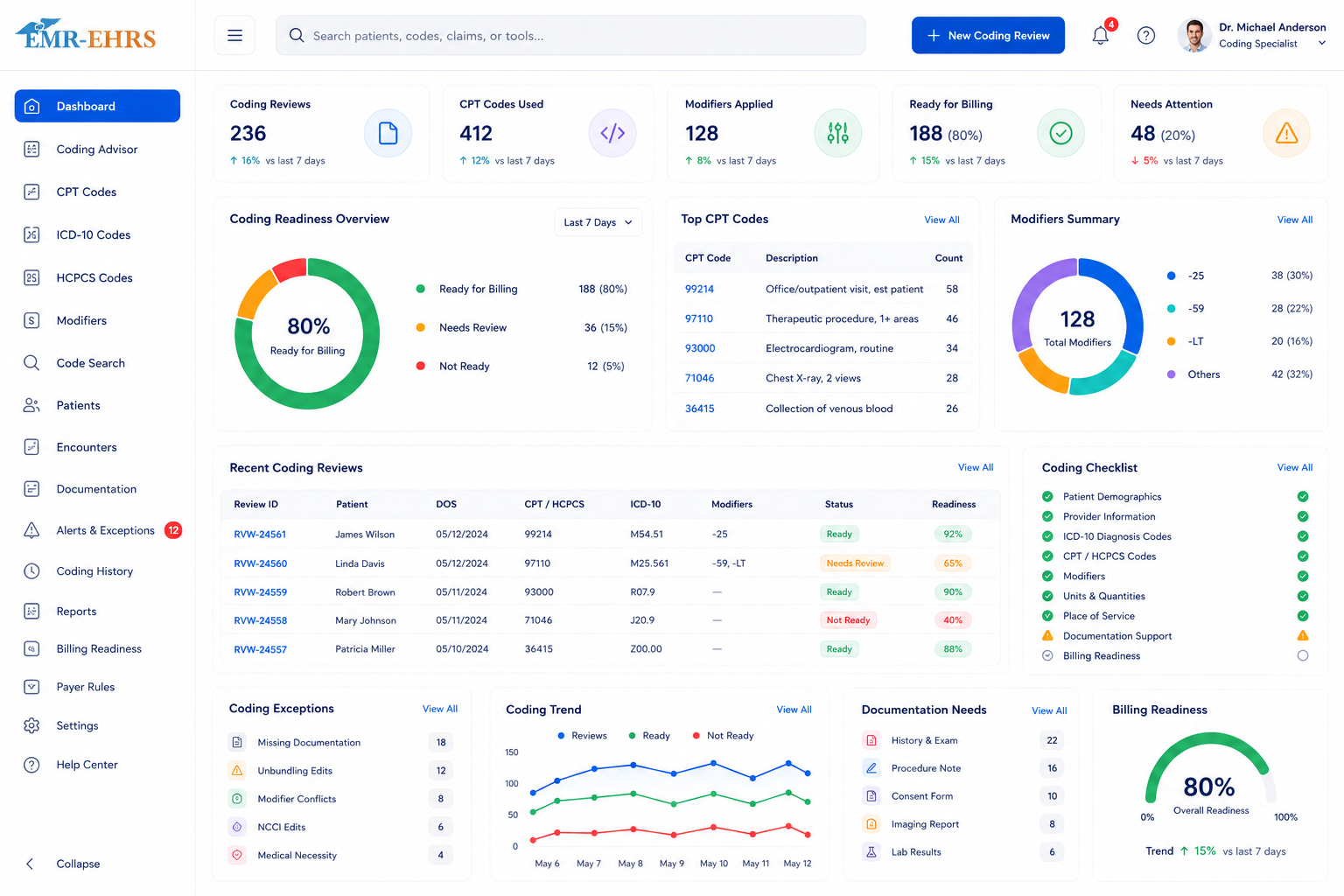
EMR CPT coding advisor software helps healthcare practices review procedure codes, diagnosis codes, modifiers, units, documentation details, and billing readiness before claims are prepared or submitted. It can support CPT code review, HCPCS code review, ICD-10 diagnosis review, procedure-to-diagnosis linking, modifier review, coding warnings, exception worklists, claim preparation, and secure coding history where supported.
EMR-EHRs CPT Coding Advisor Software helps providers, coders, and billing teams review CPT codes, HCPCS codes, ICD-10 diagnosis codes, modifiers, procedure-to-diagnosis links, coding exceptions, documentation needs, billing readiness, and secure coding history where supported.
Healthcare practices need a connected coding workflow before billing so providers, coders, and billing teams can review codes, modifiers, diagnosis links, documentation needs, and claim readiness in one place where supported.
Searching separate references for CPT codes, HCPCS codes, ICD-10 codes, modifiers, and coding notes can slow down charge review and claim preparation.
Incorrect CPT or HCPCS code selection may create claim correction work, payer questions, billing delays, or internal review tasks.
Procedure codes and diagnosis codes should be reviewed together where supported so billing teams can see coding context before claim preparation.
Billing teams need visibility into whether selected diagnosis codes support selected procedure codes where supported.
Modifier errors can affect claim line accuracy, procedure distinction, payer review, and billing follow-up.
Coding review should not stop at CPT codes. Units, service date, place of service, provider, location, and claim field completeness also matter.
When superbills, charges, encounters, and claims are reviewed separately, coding issues can be missed before billing.
Missing CPT codes, missing diagnosis codes, invalid codes, duplicate codes, modifier issues, unit issues, or field issues should be visible where supported.
Procedure combinations, unit limits, modifier indicators, and code-pair issues may need review where supported.
Some services may require supporting diagnosis details, documentation notes, payer policy review, or provider clarification where supported.
Providers, coders, and billing teams need a connected way to ask questions, request documentation, hold charges, and resolve coding issues.
Coding review should help billing teams know whether a charge or claim is ready, needs correction, needs provider review, or should stay on hold.
Managers need visibility into coding issues, held charges, correction volume, provider trends, coding worklists, and claim readiness.
Coding workflows include patient data, clinical information, billing details, staff actions, and claim preparation history.
AI can support summaries and suggestions where available, but providers, coders, and billing teams remain responsible for final coding and billing decisions.
Staff selects an encounter, superbill, charge entry screen, or claim draft where supported.
Staff reviews CPT codes, procedure descriptions, service details, and related coding notes where supported.
If applicable, staff reviews HCPCS codes, descriptions, units, and service-line details where supported.
Staff reviews ICD-10 diagnosis codes, diagnosis order, diagnosis descriptions, and claim diagnosis details where supported.
The workflow helps review whether selected diagnoses are linked to selected CPT or HCPCS procedure lines where supported.
Billing teams review diagnosis pointers, primary diagnosis pointers, multiple diagnosis pointers, and service-line diagnosis relationships where supported.
Staff reviews required modifiers, missing modifiers, invalid modifiers, incompatible modifiers, or claim-line modifier details where supported.
Staff reviews units, service quantity, place of service, provider details, location details, and service date.
Warnings may include missing CPT codes, missing HCPCS codes, missing diagnosis, invalid codes, duplicate services, modifier issues, diagnosis pointer issues, unit issues, or claim field issues where supported.
Staff reviews coding edit issues, code-pair warnings, unit limit warnings, mutually exclusive code issues, and override notes where supported.
The workflow may support diagnosis documentation review, procedure note connection, medical necessity review, payer notes, service limitations, or documentation request tasks where supported.
Providers, coders, or billing users add coding notes, correction notes, provider questions, documentation requests, or billing review comments where supported.
Coding exceptions can be routed to provider, coder, billing, or documentation worklists where supported.
The encounter, charge, or claim can be marked ready for billing, needs coding review, provider review needed, documentation needed, or hold for correction where supported.
Reviewed coding details support charge review, claim draft creation, electronic claims workflow, and billing handoff where supported.
Coding history, correction history, review notes, claim hold history, and user activity are stored where supported.
Managers review coding issues, held charges, correction trends, provider coding patterns, worklists, and billing readiness reports.
Confirm support for CPT lookup, HCPCS lookup, code status alerts, replacement codes, code updates, or specialty code libraries, including configuration and implementation requirements, during evaluation.
Confirm support for ICD-10 search, diagnosis specificity warnings, automatic diagnosis linking, or code validation, including configuration and implementation requirements, during evaluation.
Confirm support for modifier recommendations, modifier rules, coding edit modifier logic, or payer-specific modifier alerts, including configuration and implementation requirements, during evaluation.
Confirm support for claim-scrubbing, automatic code validation, payer-specific edits, or denial-prevention logic, including configuration and implementation requirements, during evaluation.
Confirm support for coding edit checking, bundling logic, unit edit review, or override workflows, including configuration and implementation requirements, during evaluation.
Confirm support for LCD/NCD support, payer policy matching, medical necessity validation, or documentation automation, including configuration and implementation requirements, during evaluation.
HIPAA-focused coding workflow, designed to support secure coding and billing access, audit-friendly coding review records, and role-based coding permissions.
Confirm support for specific clearinghouses, payer networks, CPT libraries, HCPCS libraries, ICD-10 libraries, coding edits, APIs, HL7/FHIR, or claim-scrubbing integrations, including connection method and implementation scope, during evaluation.
AI-powered coding tools should support staff review and workflow efficiency while providers, coders, and billing teams remain responsible for final code selection, documentation review, modifier use, claim preparation, compliance decisions, and billing submission.
Summarize missing codes, diagnosis support, modifier review, and coding exception details where available.
Help surface documentation needs, provider questions, and billing handoff notes for review.
Support coding exception prioritization, billing readiness review, and claim preparation handoff.
Review coding questions, documentation requests, procedure details, diagnosis support, and billing readiness where supported.
Review CPT codes, HCPCS codes, ICD-10 codes, modifiers, diagnosis pointers, documentation notes, and coding exceptions where supported.
Use reviewed coding details to prepare charges, claims, corrections, billing notes, and claim readiness worklists.
Review coding-related claim risks, correction tasks, held charges, billing readiness, and claim preparation workflows.
Monitor coding issues, held charges, correction trends, provider coding patterns, staff worklists, and claim readiness.
Manage provider-specific coding review, coding notes, billing readiness, coding holds, and coding reports where supported.
Use specialty-specific coding workflows, procedure groups, modifiers, diagnosis support, and documentation review where supported.
Manage role-based access, reports, user permissions, coding review workflows, and audit-friendly activity where supported.
| Workflow Area | Manual Coding Review | EMR-EHRs CPT Coding Advisor |
|---|---|---|
| Code lookup | Separate references | Connected code review where supported |
| CPT review | Manual search | CPT review workflow where supported |
| HCPCS review | Manual search | HCPCS review where supported |
| Diagnosis review | Separate diagnosis check | ICD-10 review where supported |
| Diagnosis linking | Manual pointer review | Diagnosis linking where supported |
| Modifier review | Manual judgment | Modifier review support where supported |
| Units and place of service | Manual claim review | Units and place of service review |
| Provider/location details | Manual field review | Provider and location detail review |
| Coding warnings | Manual detection | Coding warnings where supported |
| Documentation support | Staff messages | Documentation task workflow where supported |
| Coding issues | Notes or spreadsheets | Coding exception worklists where supported |
| Billing readiness | Manual handoff | Billing readiness status where supported |
| Reports | Manual tracking | Coding and claim readiness reports |
| Security | Shared notes or files | Role-based access and audit-friendly history |
This conceptual workflow preview illustrates a CPT coding advisor dashboard mockup.
Procedure code review where supported.
Diagnosis panel and pointers where supported.
Coding warnings and documentation tasks.
Billing readiness and claim preparation indicator.
EMR-EHRs helps practices connect coding review with encounters, charges, claims, billing readiness, and reports where supported.
EMR-EHRs can support CPT code review, HCPCS code review, ICD-10 diagnosis review, and coding notes where available.
EMR-EHRs helps teams review modifiers, units, service details, provider details, and location details where supported.
EMR-EHRs supports coding review before claim preparation so billing teams can identify missing or incomplete coding details where supported.
EMR-EHRs helps manage coding issues, provider questions, documentation requests, correction tasks, and billing holds where supported.
EMR-EHRs supports role-based access, secure coding activity, review notes, and audit-friendly coding history where supported.
EMR-EHRs can support coding summaries, missing code suggestions, documentation gap summaries, exception prioritization, and claim readiness summaries where available.
EMR-EHRs helps configure coding workflows, user roles, reports, billing readiness statuses, worklists, and staff training.
Review encounter coding, superbills, charge entry, diagnosis entry, modifier review, coding corrections, documentation requests, claim preparation, and billing handoff.
Configure CPT review fields, HCPCS review fields if supported, procedure code fields, code descriptions, coding notes, and charge entry connection where supported.
Configure ICD-10 fields, diagnosis order, diagnosis notes, claim diagnosis connection, and diagnosis review workflow where supported.
Configure procedure-to-diagnosis linking, diagnosis pointers, service-line diagnosis review, and billing readiness rules where supported.
Configure modifier fields, unit fields, service quantity, place of service, provider details, location details, and claim-line review where supported.
Configure encounter coding review, superbill review if supported, charge entry review, provider review tasks, coder review tasks, and billing review tasks.
Configure missing code warnings, missing diagnosis warnings, modifier warnings, duplicate code warnings, unit warnings, claim field warnings, coding exception statuses, and claim readiness statuses where supported.
Configure documentation request tasks, provider questions, procedure note review, coding notes, correction notes, and review statuses where supported.
Configure coding exception queues, assigned owners, priorities, due dates, review statuses, resolution statuses, completion statuses, and coding hold statuses where supported.
Configure ready for billing, needs coding review, needs provider review, needs documentation, hold for correction, and claim preparation statuses.
Configure coding reports, correction reports, held charge reports, claim readiness reports, provider coding reports, staff productivity reports, and coding worklists.
Configure provider access, coder access if supported, billing access, report access, coding edit permissions, claim edit permissions, and audit-friendly activity.
Configure AI coding summaries, missing code suggestions, documentation gap summaries, coding exception prioritization, claim readiness summaries, and billing handoff summaries where available.
Train providers, coders, billing teams, RCM teams, administrators, and practice managers.
Monitor coding issues, correction volume, held charges, provider questions, documentation requests, billing readiness, claim readiness, and report accuracy.
EMR CPT coding advisor software helps healthcare practices review procedure codes, diagnosis codes, modifiers, units, documentation details, and billing readiness before claims are prepared or submitted. EMR-EHRs CPT Coding Advisor Software can support CPT code review, HCPCS review, ICD-10 diagnosis review, procedure-to-diagnosis linking, modifier review, coding exceptions, claim readiness, and secure coding history where supported.
EMR-EHRs helps providers, coders, and billing teams review coding details from encounters, superbills, charge entry, or claim drafts where supported. The workflow can support CPT code review, HCPCS review, ICD-10 diagnosis review, diagnosis pointer review, modifier review, units review, place of service review, coding notes, correction tasks, and billing readiness status.
Yes, where supported. EMR-EHRs CPT Coding Advisor Software can help teams review CPT modifiers, modifier fields, diagnosis pointers, procedure-to-diagnosis links, service-line diagnosis relationships, and claim-line coding details. It can also flag missing modifiers, invalid modifiers, missing diagnosis pointers, or diagnosis mismatch issues where supported.
EMR-EHRs can support coding warnings before claim submission where available, including missing CPT codes, missing HCPCS codes, missing diagnosis codes, duplicate codes, modifier issues, unit issues, place of service issues, diagnosis pointer issues, provider field issues, documentation requests, and claim readiness warnings. These warnings help teams review coding issues before billing or claim preparation.
Practices should use an integrated CPT coding advisor because manual code review often requires disconnected code searches, separate diagnosis review, manual modifier checks, spreadsheet notes, and delayed billing handoffs. EMR-EHRs CPT Coding Advisor Software supports connected coding review, coding exception worklists, billing readiness status, coding history, reporting, and audit-friendly review records where supported.
Review CPT codes, HCPCS codes, diagnosis details, modifiers, units, documentation needs, coding issues, and billing readiness with EMR-EHRs CPT Coding Advisor Software where supported.
Phone: (480) 782-1116 | Email: jason@1stproviderschoice.com